Listen to the audio version of this article (generated by AI).
If you’re publishing more content, but without traffic, impressions, or conversions, the problem may not be your content itself. Google now prioritizes topical authority, not just content volume. If you have thousands of pages competing in the SERP, you need to rethink your content strategy for better performance with pillar pages SEO.
By organizing your content into structure topic clusters, pillar pages help search engines better understand and recognize your expertise in your niche. This strengthens your overall topical authority.
If you don’t know where to start, this guide covers everything you need. You will learn what SaaS SEO pillar pages are, why they matter, how they work, common types, and how to build them effectively.
What are Pillar Pages SEO
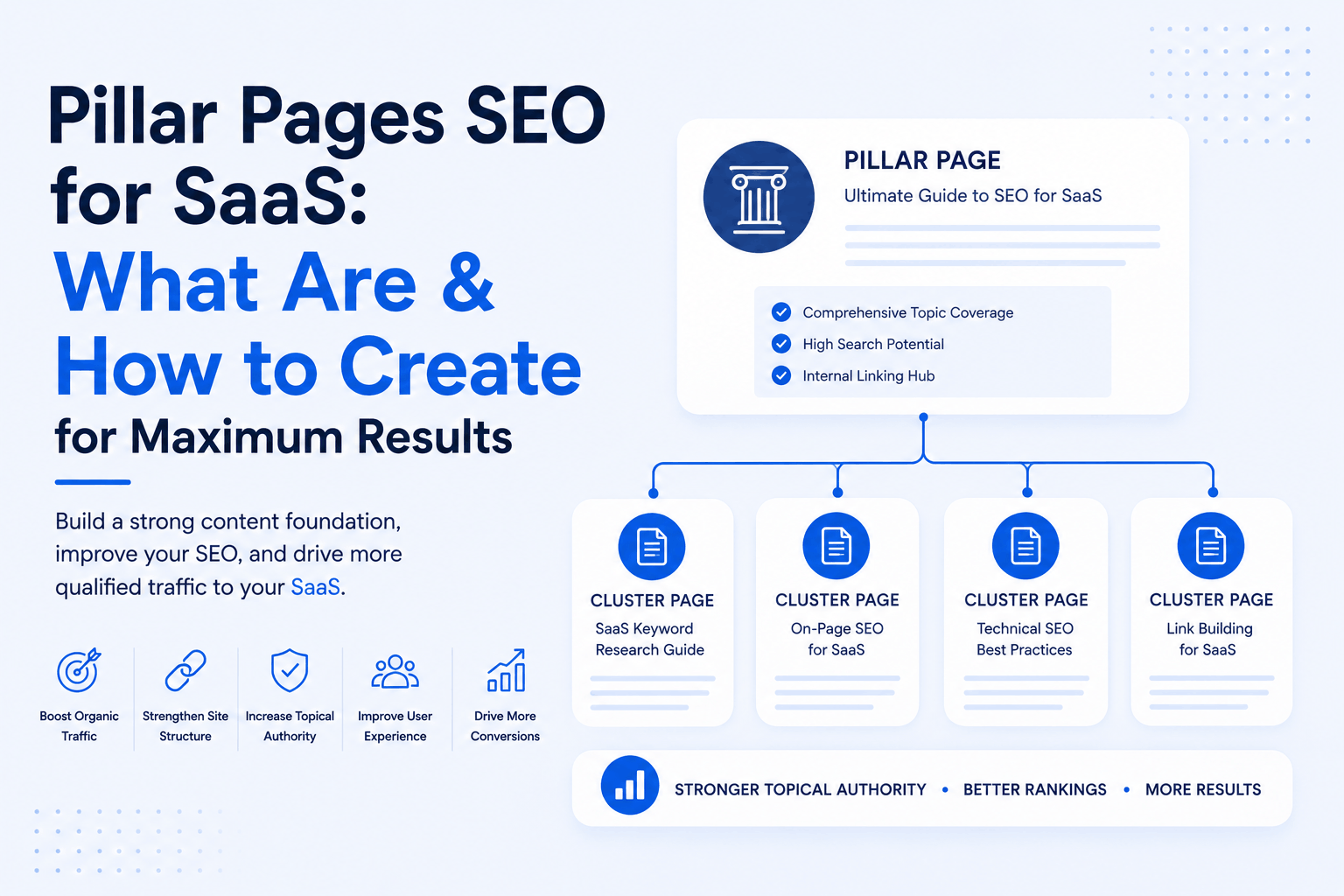
Pilar pages in SEO, also called content pillars, are strategically structured posts that are the foundation of a topic cluster – pieces of content that establish topical authority on a specific topic.
They act as a central hub for a broad topic that you can link out to more detailed subtopics covering the subject matter.
In turn, cluster pages can also link back to the pillar page to strengthen authority, relevance, SEO performance, and help search engines understand your content structure.
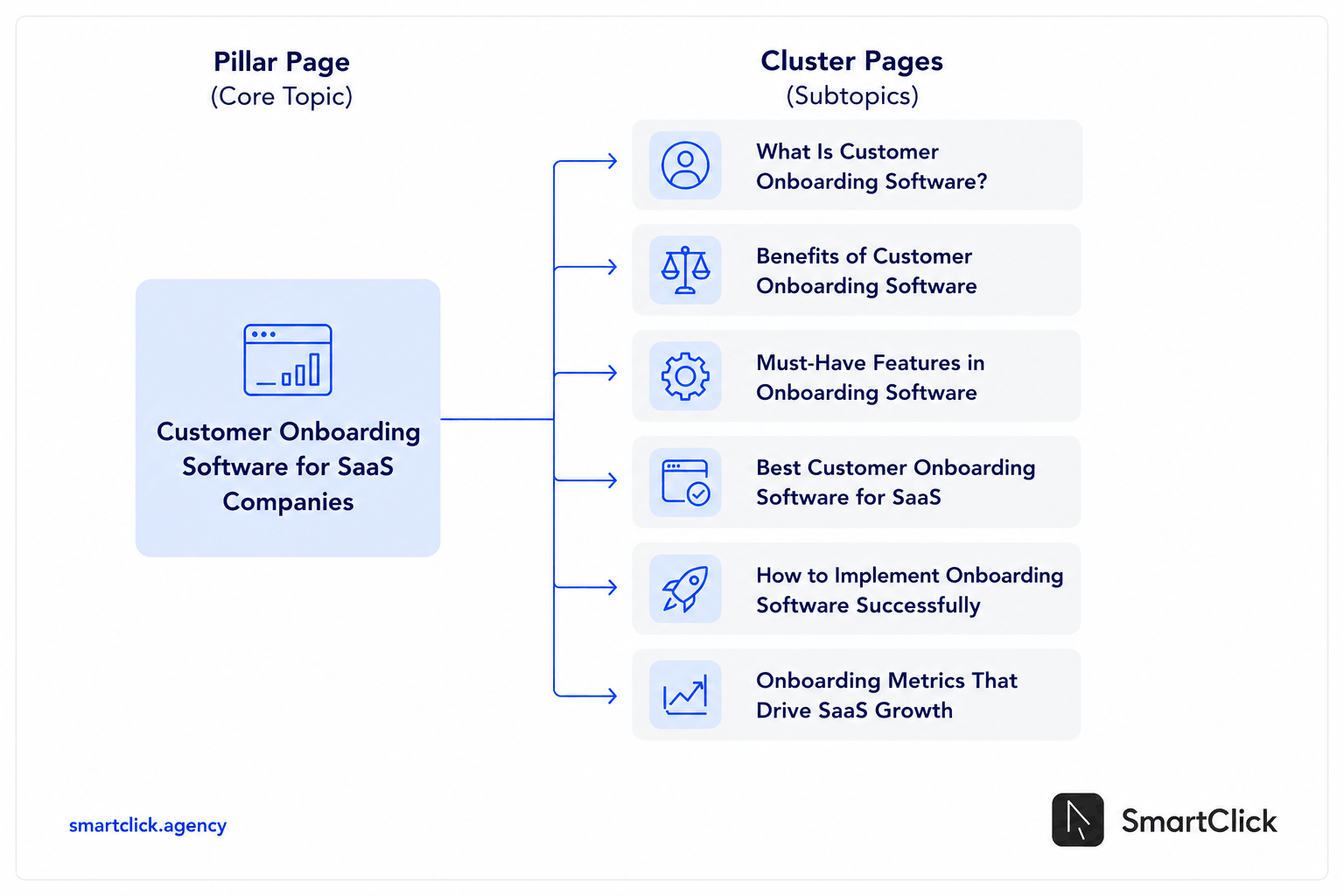
Let’s see how visually this looks:
As you can see from the image, there is a main pillar page that leads readers to more related specific topics.
When you create a pillar page, you provide a broad, high-level overview of the core topic. This is a long-form guide that covers multiple angles rather than focusing on a single keyword.
Together with creating content clusters, you showcase your expertise in your niche, signaling search engines that you are an authority on that topic.
Earning Natural Backlinks
When you provide in-depth content with a high level of knowledge, you naturally attract more backlinks. This leads to more citations as pillar pages are shared more often compared to less comprehensive content.
Improving Internal Linking Strategy
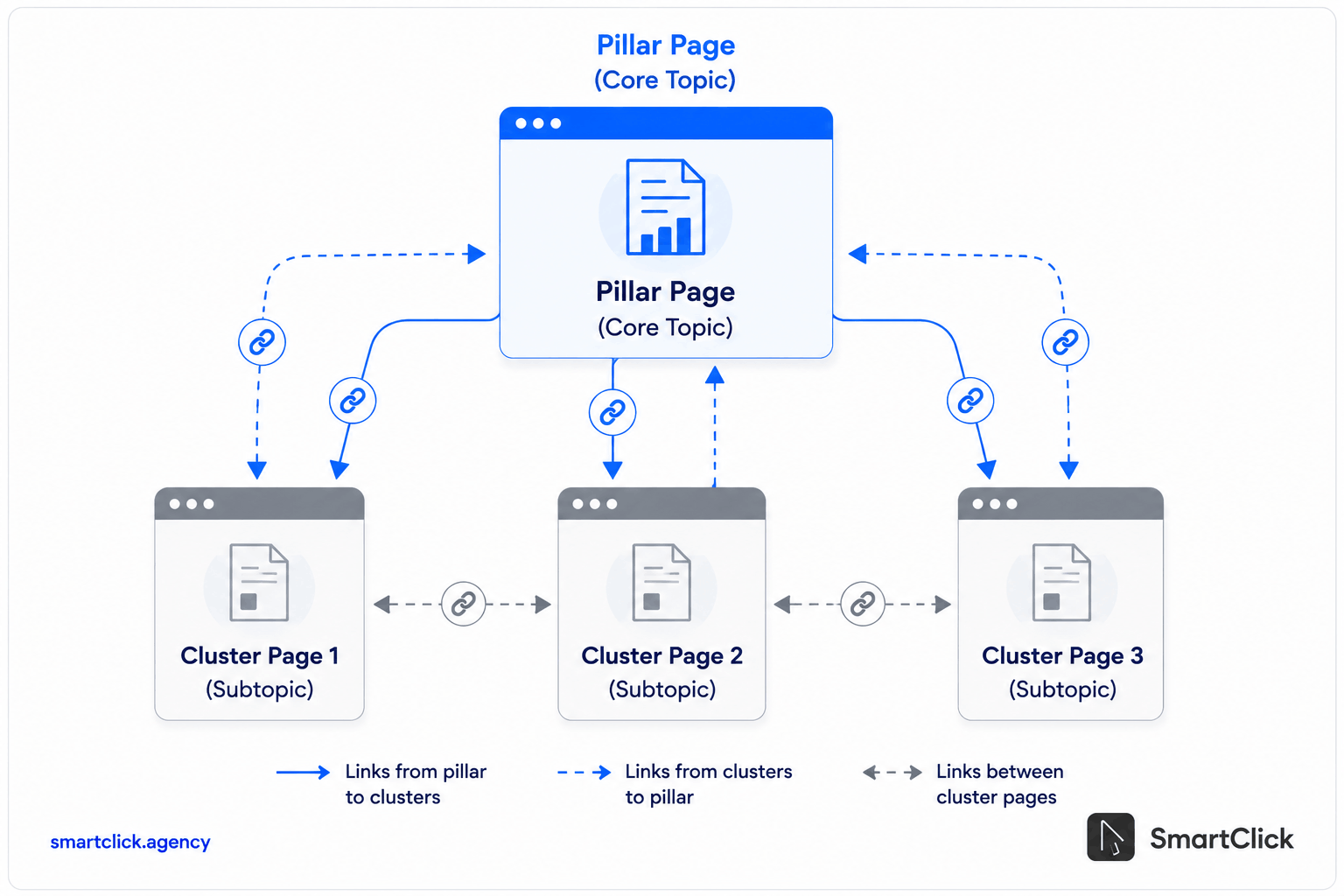
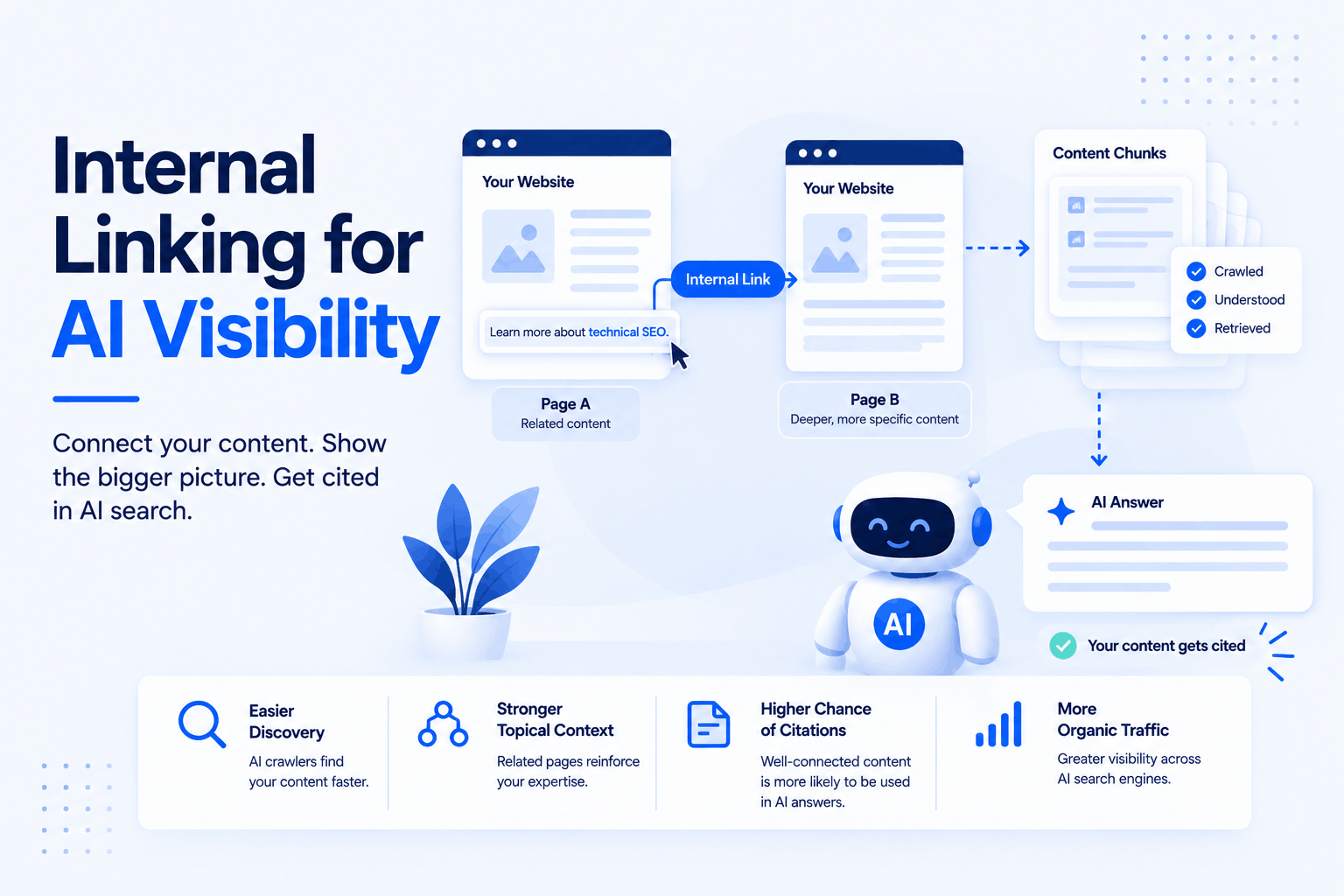
Internal links help your content connect to each other. If done right, your pillar page should link to all related content clusters, and your content clusters should link back to the pillar page. And also, where possible, your content clusters should link to each other.
Take a look at the example below.
This strengthens your page, making it easier for search engines to understand your content.
Avoiding Keyword Cannibalization
When you write new content, you create it based on regular keyword research using SEO tools, competitor analysis, and so on. If you don’t follow a certain content strategy, you risk keyword cannibalization – creating two pages on the same topic competing with each other on SERP.
Pillar pages and content clusters solve this. They are created using a structured content framework with a clear hierarchy that helps search engines understand the purpose of each page and how they relate to one another.
Instead of competing for rankings, they work together to strengthen their topical authority and improve Google and AI visibility.
Improving User Experience
When readers land on your page, they want to find their answers quickly and navigate to relevant information without friction. Start creating organized pillar pages, supported by content clusters.
A well-structured pillar page breaks down a broad topic into more digestible subtopics and questions, making it easier for the reader to skim. Google and LLMs favor this structure too.
Clear topic organization, intuitive navigation, and strong internal linking are some of the LLM SEO best practices you can implement to improve your chances of getting cited.
How to Create Pillar Page SEO for SaaS
Here’s how to create a pillar page for SaaS effectively:
Identify Your Core Topics
Before starting to write, you need to identify what your pillar page will be about.
Pick a topic that is close to what your customer’s needs. Think about it this way: your ICP isn’t searching for your product. They’re searching for the problem your product solves.
A good pillar topic should rely on three things:
A problem your ICP searches for before they know your product exists
A subject broad enough to support 8–15 supporting articles around it
Something your product helps with
For example, topics for your SaaS SEO pillar page can be:
Project management
Workflow automation
SaaS SEO tool
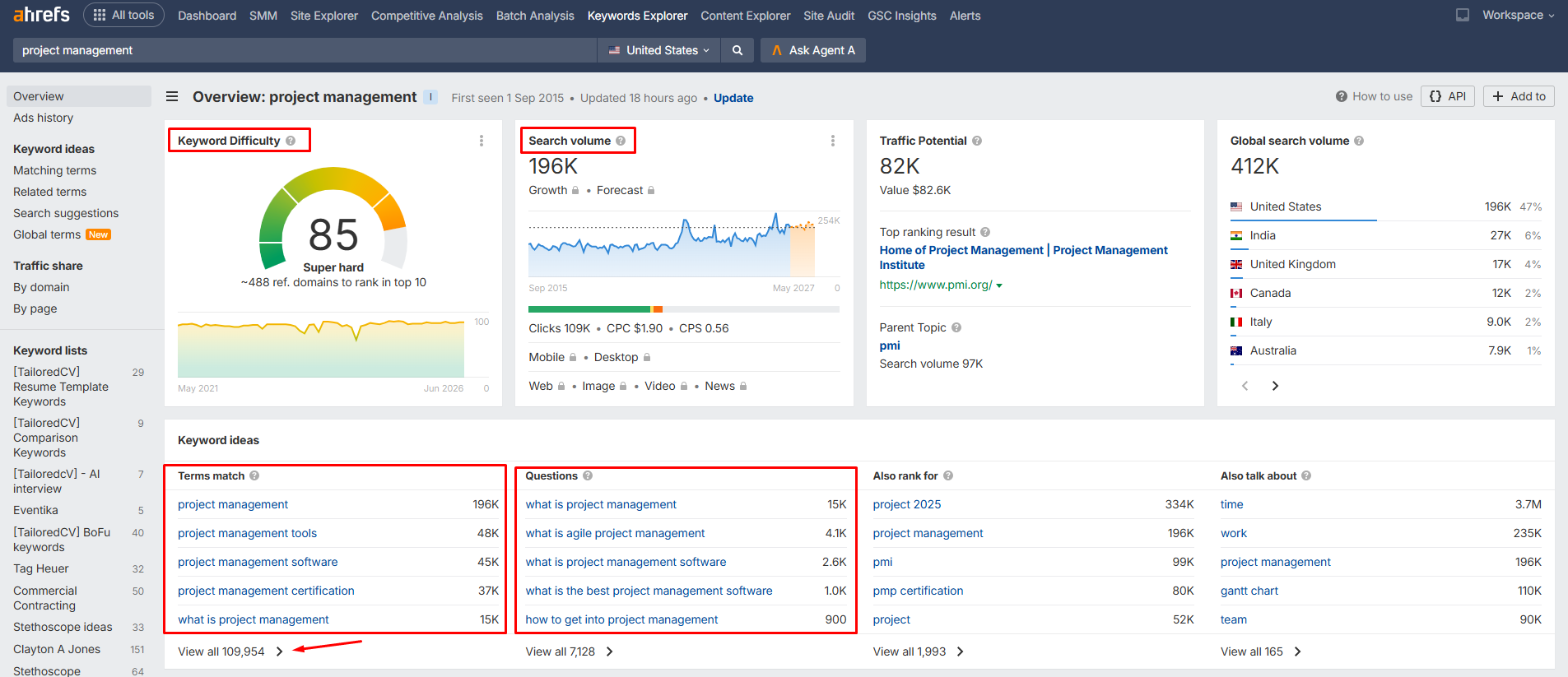
Let’s take “project management” as an example. To create a pillar page, you should cover the topic comprehensively and link to more detailed cluster content. Using Ahrefs, here are some subtopics you could include:
Besides the main keyword, users also search for related terms, which appear in “Terms match” and “Questions”.
Each of these subtopics can be content clusters that link to one another and back to the main pillar page. Pay attention to the search volume of each keyword and how difficult it is to rank for.
Therefore, start by listing the 3-5 biggest problems your customers came to you to solve. Those are your pillar topics.
Match With Search Intent
Once you’ve got the core topic, you need to understand why users are searching for it. It is important to match every stage of the SEO funnel as it shapes how you will structure your content.
There are four types of search intent:
Informational: People want to learn something.
Navigational: People want to find a specific website, page, or resource.
Commercial: People are researching solutions and comparing options.
Transactional: People are ready to take action or make a purchase.
If we take, for example, “project management software”, usersmay have different search intents depending on their stage in the buying journey.
So, first, write more broadly about “project management software,” while the cluster pages will address the different search intents surrounding that topic, like:
Informational: “What is project management software?” or “Benefits of project management software”
Navigational: “Asana login” or “Monday.com pricing”
Commercial: “Best project management software for small businesses” or “Asana vs Trello”
Transactional: “Buy project management software” or “Start free trial for project management software”
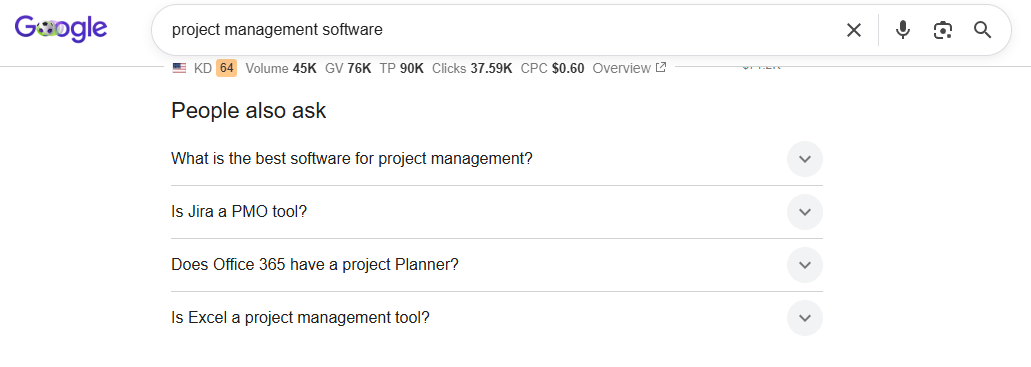
Also worth paying attention to is the “People Also Ask” (PAA) box on Google. These questions reveal what users are actually curious about and are perfect for structuring your pillar page into clear H2 and H3 sections.
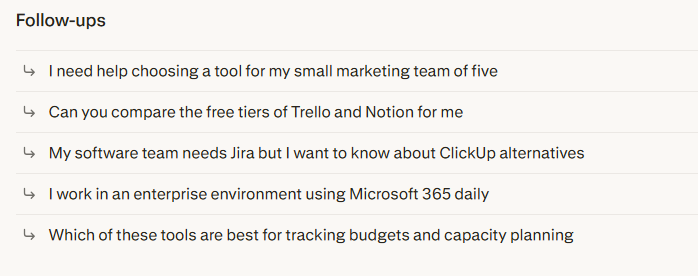
In addition, tools like Perplexityoften surface follow-up questions and related prompts based on user intent. These follow-ups show how people naturally expand their queries after the first answer.
You can use this as H2 and H3 sections or as content ideas for your next cluster content.
Structure Your Content for Google and LLMs
How you structure your content matters not only for better rankings, but also for improving your visibility in AI search. People are now using long, conversational queries in LLMs to find direct answers.
If AI systems recognize your brand as trustworthy and relevant, they are more likely to surface and cite your content in AI-generated responses.
Here’s a structure that works for SaaS pillar pages:
Open with a direct solution, not a definition. If your pillar page starts with “what is” or “how to”, start with a clear outcome that will make them feel seen.
Use a clear heading structure. Divide each section with H2 and H3, respectively. Use bullet points to break down complex information. Try to answer the question so that your reader doesn’t need to go anywhere else.
Add an FAQ section. FAQs are one of the highest-ROI additions to a SaaS pillar page. Write them in plain, direct language with a clear 3-5 sentence answer. They are easy for Google to pull into feature snippets or LLMs to cite in their generated answers.
End with a natural CTA. Don’t force with “Start a free trial” CTA if you are writing an informational guide. “Book a free consultation”, “Sign up for newsletter”, and similar work better.
Implement an Internal Linking Strategy
As a last step before publishing your content, add internal links. As mentioned before, your pillar page should include links to the content clusters, and each cluster page should link back to the pillar.
When implementing internal linking best practices, use descriptive anchor text. Avoid generic phrases like “click here” or ”learn more” as they don’t bring any value and may be a bad sign for Google.
To choose effective anchor text, match it closely to the topic of the destination page while keeping it natural in the sentence. Ideally, it should reflect the main keyword or a close variation without sounding forced. This improves crawlability, relevance signals, and overall SEO performance.
Types of SaaS Pillar Pages SEO
There are several types of pillar pages SEO. Each is designed to serve a different purpose based on the user’s search intent.
1. “Guide” Pillar Page
This is a comprehensive, long-form content that covers a broader topic end-to-end. It is great for people who want to educate themselves.
This format is built for people who are actively trying to understand. This kind of content defines a topic, gives explanations and examples to help readers understand all aspects of the subject.
Some SaaS pillar pages examples here include:
“What is Product-Led Growth?”
“What is the Best SEO Strategy for SaaS Businesses?”
“What is Brand Mention for SEO?”
3. Listicle Pillar Page
This is the best-organized content structure that Google and LLMs favor. The information is structured as a list, making it easy for readers to skim and understand, and it can also appear in AI Overview, featured snippets, and AI-generated answers.
Listicles pillar pages work best for MOFU (middle of the funnel), where your audience is comparing before choosing.
Here are some examples:
“12 Best SaaS SEO Strategies to Increase Organic Traffic”
”10 Essential SaaS Marketing Tools for Startup Growth”
”15 SaaS Metrics Every Product Team Should Track”
4. How-To Pillar Page
This type of pillar page is all about guiding your reader through a clear, step-by-step process to achieve something they actually care about.
Instead of just explaining a concept, you’re showing them exactly how to do it in real life. This kind of content increases the likelihood of earning backlinks naturally, as it demonstrates something that actually helps rather than just understanding it.
This kind of pillar page should look like this:
“How to Optimize SaaS Blog Content”
“How to Create an SEO Strategy for A SaaS Product”
“How to Deal With Specific SEO Challenges for SaaS”
Pillar Page SEO vs. Cluster Content
We should compare the pillar page and cluster content side by side to understand the differences.
Aspect
Pillar Page
Cluster Content
Purpose
Covers a broad topic in depth and acts as the main hub
Covers specific subtopics related to the pillar in detail
Scope
Wide, high-level overview
Narrow, focused deep dives
Target Keywords
Broad, high-volume keywords
Long-tail and niche keywords
Search Intent
Mostly informational, sometimes mixed intent
Usually, specific informational or commercial intent
Internal Linking
Links out to all cluster pages
Links back to the main pillar page
User Role
Helps users understand the full topic
Helps users explore specific questions or problems
SEO Role
Builds topical authority and ranks for core terms
Supports pillar rankings and captures long-tail traffic
Example (SaaS)
“Project Management Software Guide”
“Best project management tools for startups”
Conclusion
Pillar pages SEO are one of the most strategic moves for your SaaS business. They help search engines clearly understand what your site is about, build topical authority over time, and turn your blog into a connected, structured system.
As a B2B SaaS SEO, SmartClick can help you build pillar content, get the structure right, map the right clusters, and execute it consistently to build topical authority, avoid keyword cannibalization, and improve overall search visibility.
FAQs
What is an example of a pillar page?
In SaaS SEO, a pillar page could be “Project Management Software: Complete Guide.” This page would cover the topic broadly and then link to deeper articles in content clusters such as “Best project management tools,” “How to choose project management software,” and “Project management methodologies.”
Are pillar pages an effective strategy?
Yes, when done right, pillar pages are one of the most effective ways for your SEO SaaS strategy. Because they focus on broader topics supported by a cluster of related articles, they attract traffic at every stage of the funnel simultaneously.
What are the differences between pillar pages SEo and other blog categories?
A regular blog post targets one specific keyword and stands alone. A pillar page is a hub that covers a broad topic and intentionally connects to a network of supporting articles.
How to structure my SEO SaaS pillar page for maximum AI visibility?
Use clear, descriptive H2s and H3s for every subtopic, include a FAQ section, add internal links, and write in a natural, conversational tone. Answer questions directly, and avoid generic information. The more your pillar page feels like a complete, authoritative resource on the topic, the more likely it is to appear in AI-driven results like Google AI Overviews, Perplexity, and ChatGPT responses.
Let’s Solve Your SEO Challenges and Bring You Traffic That Converts
Book a free consultation today to learn how we can help you attract more of the right traffic and turn it into qualified leads for steady growth.