Listen to the audio version of this article (generated by AI).
Before an AI engine starts to cite your page, it needs to access your content, read, understand, and trust what it finds. That’s what technical GEO is about – the same SEO fundamentals, including crawlability, content structure, and clean schema markup.
While creating high-quality content, building strong E-E-A-T signals and authority matter, technical GEO provides the foundation that helps AI systems access and retrieve your content.
This article covers everything you need to know for technical GEO and how to make your website easier for AI systems to crawl, access, understand, and retrieve.
What is Technical GEO?
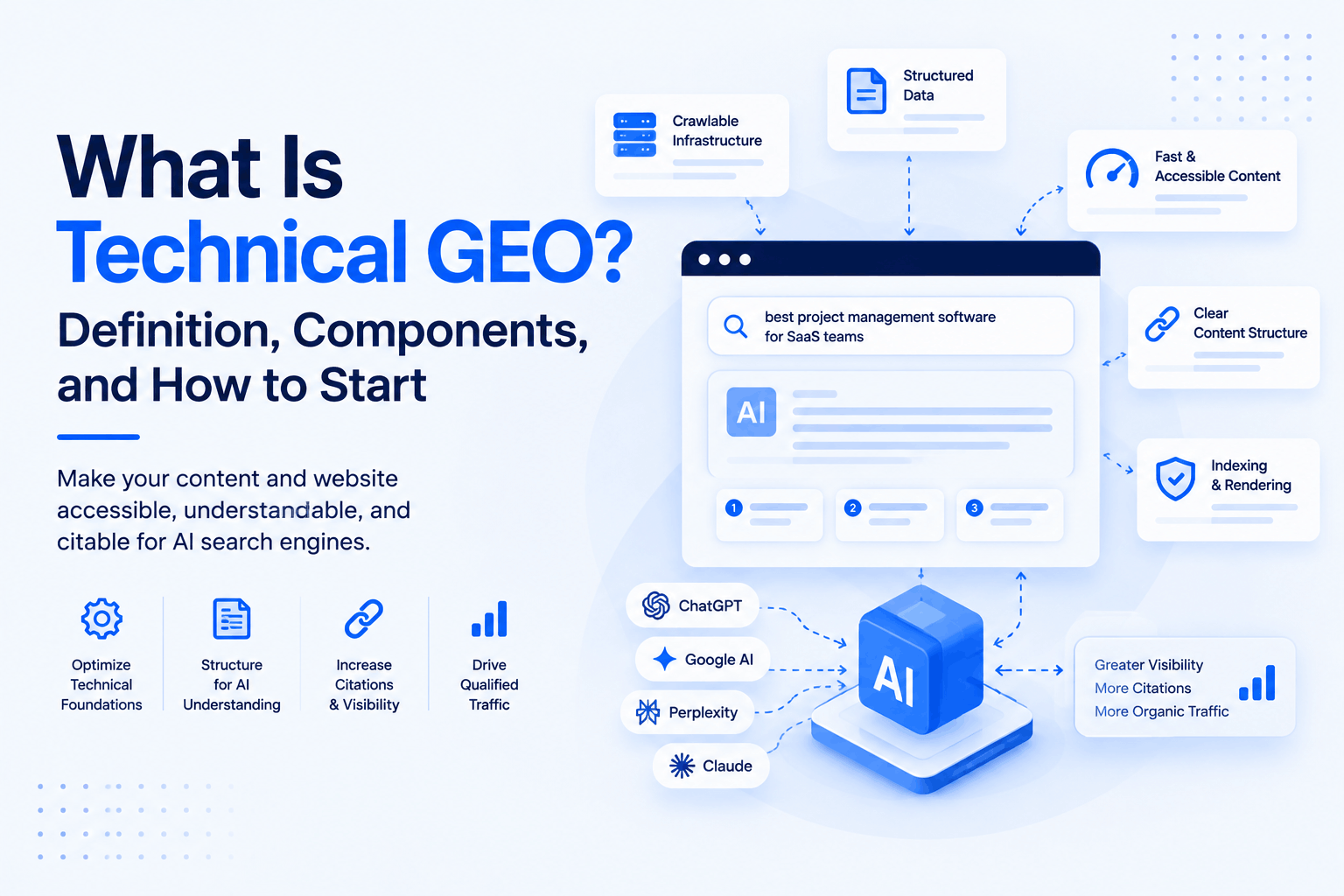
Technical GEO is the practice of configurating a website’s backend code, file structure, and markup so AI search engines can crawl it, extract its content accurately, and cite it as a relevant source in generated answers.
It is an additional layer to a solid SEO foundation, where the main focus is the infrastructure. And it doesn’t guarantee that your content will be cited. It only makes it eligible for citation.
How Does It Work?
Technical GEO works differently than traditional SEO. In traditional search, Google indexes the pages before you start searching for something. When you search, Google uses this stored information to quickly find and show you the most relevant pages.
But AI search systems can use retrieval-augmented generation (RAG) to retrieve relevant information from search indexes, databases, and, in some cases, live web pages before generating an answer. So, if your site is slow, blocks AI crawlers, or hides the content, the AI may skip your site and use another one to cite.
How Technical GEO Differs from Technical SEO
Let’s see the differences side by side.
Layer
Technical SEO asks
Technical GEO adds
HTML
Can a crawler find and render this page?
Does the key content exist in the raw HTML, or only after JavaScript runs?
Canonical / Metadata
Is there one authoritative URL for this content?
Does the metadata clearly describe what the page is about, so an AI can summarize it without guessing?
Structured Data
Does schema improve rich results in search?
Does schema help an AI verify facts, attribute authorship, and understand entities well enough to cite them?
Internal Links
Does link equity flow to important pages?
Does the site’s structure make it obvious which pages are authoritative on a topic?
Evidence / Trust Signals
Do backlinks and E-E-A-T support rankings?
Is there enough third-party corroboration and clear authorship for an AI to trust the content as a source?
AI-Specific Files
N/A
Does an llms.txt file exist to guide AI models directly?
As you can notice from the table, technical GEO isn’t replacing technical SEO for SaaS. Crawlability, indexability, relevance, authority, and user experience are part of technical SEO that are still important for how AI-generated results get their answers.
Why Technical GEO Matters for SaaS Business
Software buyers are increasingly starting their research journey on AI platforms like ChatGPT, Perplexity, and others. Instead of searching Google for “the best project management tool” and going through 10 or more blue links, they can ask an AI platform, “Find me the best project management tool.” The AI can then recommend relevant tools, compare their features and pricing, and summarize the options – all in one place.
This is especially important for SaaS businesses, where the buyer journey is often longer and involves more research. If AI crawlers can’t access your pages or quickly understand your content, your product may be less likely to appear in AI-generated answers.
That’s why GEO for SaaS companies goes beyond rankings and focuses on making the brand discoverable, understandable, and citable across AI-generated answers.
5 Technical GEO Elements to Check
Technical GEO is not just one tag or schema. It connects every part of your page for readers and AI systems to understand.
The five technical components to review include:
1. AI Crawler Permission in robots.txt
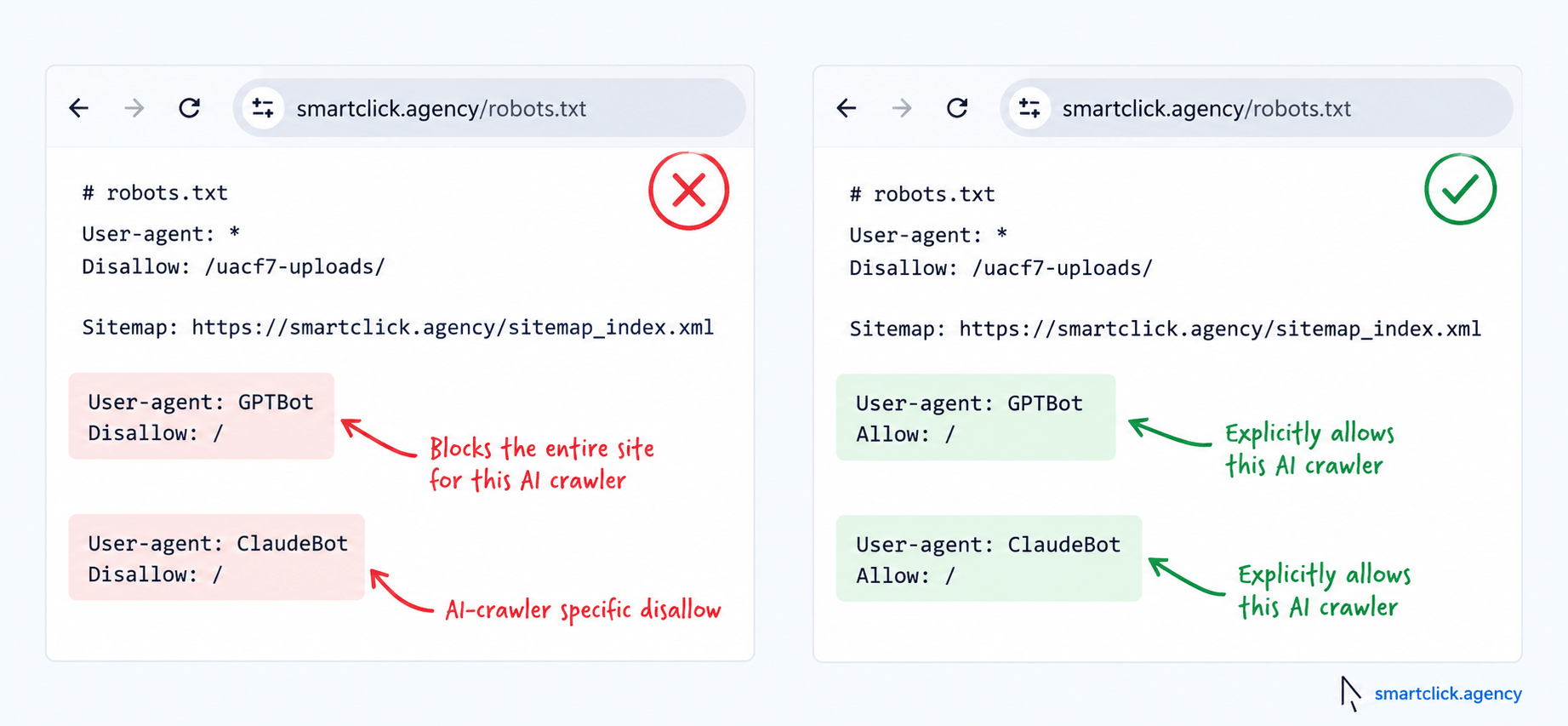
robots.txt is the file that tells crawlers what they’re allowed to touch and what to stay away from. There are different AI bots, including GPTBot, PerplexityBot, ClaudeBot, and Google-Extended, and they all serve different purposes.
So, if you block one of these, that AI system may not be able to discover or use your content.
The fix takes about ten minutes and doesn’t need a developer:
Open yoursite.com/robots.txt in a browser
Look for any Disallow:/ rules or AI-crawler-specific disallows
Add explicit Allow: lines for whichever crawlers you want to let in
2. llms.txt: An Optional File for AI Systems
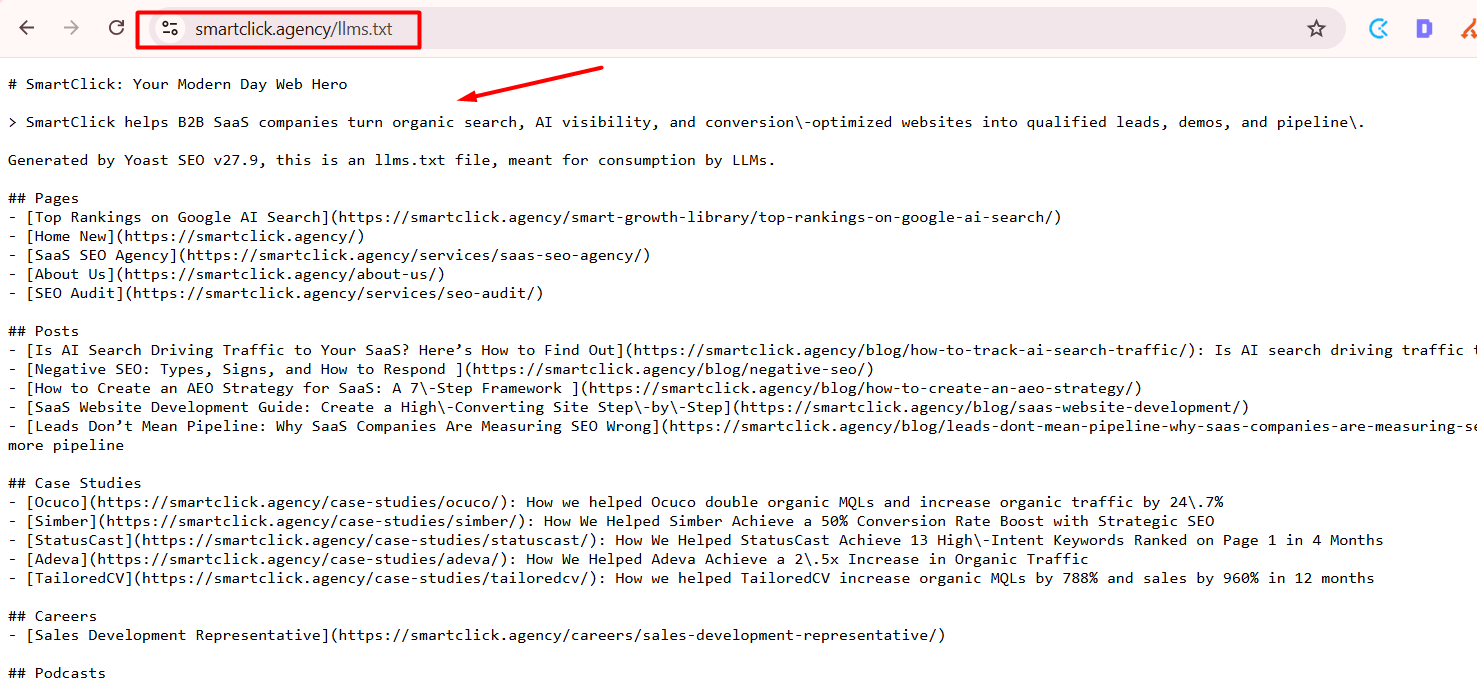
The llms.txt is a markdown text file that gives AI models a structured summary of what your site is and what it covers, including what the brand is, what the most important pages are, the topics it is known for, etc.
It is not a replacement for a sitemap or robots.txt file, so if you want to implement it, it should include:
The site name and description
Short list of key pages with short summaries
Context and details
Sections organized with H2 headers
To check whether your llms.txt file is accessible, open yoursite.com/llms.txt in a browser. It should look like this:
3. Schema Markup for AI Citation
AI systems use schema markup to identify what a page is about and how the information is structured. Schema markup provides machine-readable signals about the people, products, organizations, pages, and other entities mentioned on the page.
As AI systems scan, retrieve, and summarize information from across the web, clear structure can make it easier for them to understand your page.
Organization – establishes your brand as a verified entity with a name, URL, logo, and social profiles
Article with a named Author – attributes content to a real, checkable person, which is a meaningful E-E-A-T signal
FAQPage – describes your FAQ content in a way that is directly machine-readable
Product – it organizes information like pricing, categories, and ratings, making it especially useful for AI systems responding to comparison-based queries.
HowTo – describes the steps, tools, materials, and other elements of instructional content in structured form
LocalBusiness – for anything with a physical location, this helps AI surface the right local details
Implement this as JSON-LD in the page head, and validate it with Google’s Rich Results Test and the Schema.org validator.
Schema should also work alongside your broader AEO strategy for SaaS, where content structure, entity signals, and off-site citations contribute to AI visibility.
4. Clean HTML Rendering
This is probably the single most common way sites fail at GEO. The way your content is structured within the HTML plays an important role in how AI interprets and extracts your content.
AI engines often identify and retrieve individual sections directly in the user’s question. As part of fundamental LLM SEO best practices, your content structure should include:
Clear heading hierarchy (one H1, and H2-H3 used retrospectively)
Easy-to-understand sections under each subheading that directly answer the topic
Organized bullet points and tables to make it easier for AI systems to understand and extract useful information
Create strategic internal linking. Connect closely related pages with descriptive anchors to help AI systems understand topical relationships and identify authoritative pages. Follow a structured internal linking strategy for AI visibility to make those connections clearer for AI retrieval systems.
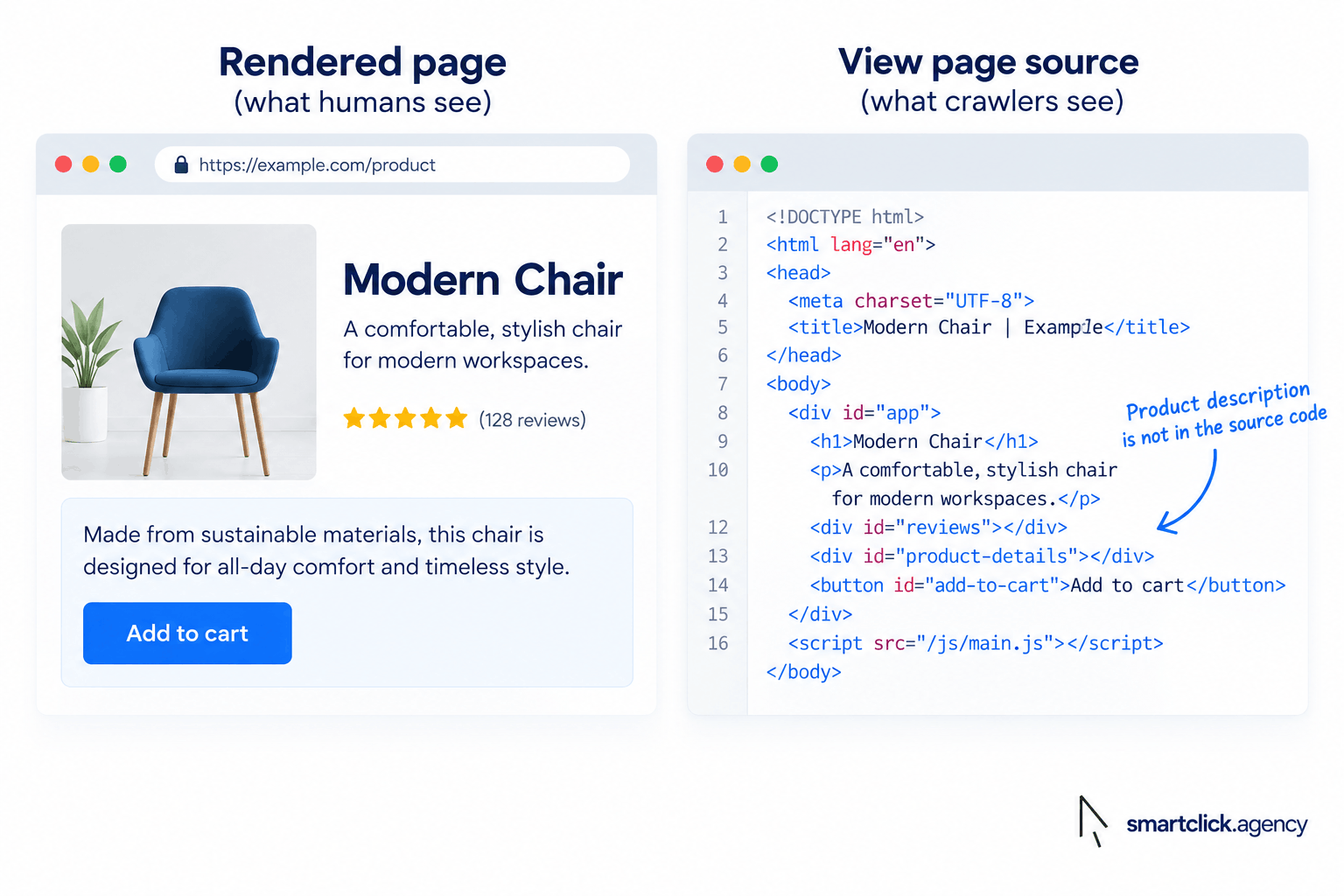
A website’s technical structure can also affect how easily crawlers process your content. AI crawlers vary in their ability to render JavaScript. If important content depends entirely on client-side JavaScript, some crawlers may not reliably access or extract it. Whenever possible, make critical content available in the initial HTML response.
To test this, view the actual page source and find a specific sentence from your content. If it’s not there, AI crawlers can’t see it either.
5. Site Speed and Performance
If your server is too slow to respond before the AI crawlers leave, your content may not appear in the answers.
To keep pages fast, compress images, remove unnecessary code, implement caching, and use a CDN to deliver content closer to users.
Start by checking that your important pages:
Return a 200 HTTP status code
Don’t experience frequent 5xx server errors or timeouts
Aren’t accidentally blocked by your CDN, WAF, or security settings
Avoid unnecessary redirect chains
Load the main content from a stable, crawlable URL
Return the important page content in the initial HTML whenever possible
You can also check your page’s Core Web Vitals on PageSpeed:
From a technical GEO perspective, these metrics are important because they help AI systems to access, interpret, and retrieve your content.
How to Check Whether Your Technical GEO Changes Worked
These are several things to pay attention to and check whether your site is technically prepared for AI crawlers:
Check
How
What success looks like
robots.txt
Open /robots.txt
Desired AI crawler isn’t blocked
HTTP response
Check URL/server
Important page returns 200
HTML
View Source
Main content exists in HTML
Schema
Schema validator
Valid markup matching visible content
Canonical
Inspect <head>
Correct canonical URL
AI crawling
Server/CDN logs
Relevant bot requests detected
llms.txt
Open /llms.txt
200 response, if implemented
Monitor the page in GSC. Watch clicks, impressions, average position, and queries the page gets impressions for, for 2-3 weeks before making any changes.
Important note: None of these checks proves you’re being cited anywhere. They prove you’re eligible to be cited.
What Technical GEO Does Not Do
Technical GEO removes the technical barriers that keep AI systems from reaching and reading your content. So, it doesn’t guarantee that your content will be cited anywhere or improve your search rankings. Also, it doesn’t replace quality content, topical authority, or E-E-A-T signals.
Technical GEO in Practice: How We Helped Our Client
The challenge: When we started working with Ocuco, the website had technical SEO issues affecting crawlability and indexing, a weak internal linking strategy, and no established GEO strategy.
Our approach: We started by auditing the technical foundation, alongside Ocuco’s existing AI visibility across different LLMs, then worked on the technical fixes, internal linking, and SEO and GEO opportunities.
The result: Significant revenue was generated from our SEO and GEO strategy. Also, Ocuco established citations across ChatGPT, Gemini, Copilot, and Perplexity.
Technical GEO isn’t a one-time task; it’s an ongoing process that should be part of every GEO strategy. Our AI SEO Services include a technical accessibility audit, where we check whether AI bots can access your page before any LLM can cite you.
This includes a full crawler accessibility report, robots.txt audit, and a prioritized fix roadmap with implementation support. So, contact us for a free consultation, see where your site actually stands in AI search, how AI models shape opinion for your brand, product, or service, and discover gaps that can be improved before your competitors get cited instead.
FAQs
Is technical GEO replacing SEO?
No, technical GEO is not replacing technical SEO. Instead, it builds on the fundamentals of technical SEO, which include crawlability, site speed, structured data, indexability, and clear site architecture.
How do I know if AI crawlers can access my website?
Start by checking your robots.txt file to make sure you’re not blocking crawlers such as GPTBot, OAI-SearchBot, PerplexityBot, or ClaudeBot. Also check that your important content is available in the page’s HTML and isn’t dependent entirely on JavaScript to render. Review your server logs or CDN analytics for requests from AI crawler user agents. Seeing these crawlers visit your pages confirms that they can access your website,
Do I need an llms.txt file for GEO?
No. An llms.txt file is currently optional, and there is no strong evidence that it directly improves AI visibility or citations. llms.txt can be tested as an additional signal, but it shouldn’t be treated as a technical GEO requirement.
Does Technical GEO guarantee AI citations?
No. Technical GEO removes the technical barrier and makes your page accessible for AI engines. It doesn’t make a page worth citing.
Let’s Solve Your SEO Challenges and Bring You Traffic That Converts
Book a free consultation today to learn how we can help you attract more of the right traffic and turn it into qualified leads for steady growth.