Listen to the audio version of this article (generated by AI).
The SaaS keyword research process is the inevitable and most important part of your SEO strategy. SaaS products offer unique values and target various audience groups, so choosing the right keywords increases organic traffic, brand awareness, and drives more leads and conversions.
There are thousands of different SaaS keywords that billions of people search for every day. So, which one should you target? What are the keyword research strategies your SaaS business should implement?
In this blog, you will learn the different types of SaaS keywords that matter and simple steps you can take to enhance the keyword research for your SaaS product.
Types of SEO Keywords for SaaS
Start your SaaS keyword research by understanding what your audience wants.
For example, imagine a team leader or manager is looking for a solution for effective team management. They type on Google different keyword variations depending on what they need. So, this is exactly what you need to understand – their intent.
Informational Intent: Keywords for those seeking information or answers, like “what is team management” or “how to manage my team effectively.”
Navigational Intent: Keywords targeting specific web pages or brands, like “SmartClick SaaS SEO” or “StatusCast login.”
Commercial Intent: Users are seeking more information before making a purchase decision, like “best team management tools” or “management tool 1 vs. management tool 2”. Content types suitable for this intent are comparison blogs, case studies, landing pages, demo videos, etc.
Transactional Intent: Users are ready to buy or sign up, like “team management free trial” or “buy team management software.” SaaS companies should target these keywords with well-optimized product pages and strong calls-to-action to convert high-intent users.
Analyze their pain points, identify the specific needs at each stage of their journey, and provide the best solution. That’s how you understand your target audience and establish a strong base for your further SaaS keyword research.
The SEO Funnel Keywords for SaaS
SEO funnel targeting through keywords is a strategic approach that helps businesses attract and guide potential customers from initial awareness to final conversion. Here’s a brief explanation of how it works:
Top of the Funnel (TOFU)
At this stage, keywords are broad and informational. They target users who are just beginning their research or becoming aware of a problem or need. Examples include:
“How to…”
“What is…”
“Benefits of…”
Middle of the Funnel (MOFU)
These keywords indicate that users are considering solutions and comparing options. They’re more specific and often include:
“Best [SaaS product/service] for…”
“[SaaS Product A] vs [SaaS Product B]”
“[Industry] SaaS solutions”
Bottom of the Funnel (BOFU)
Keywords at this stage show high purchase intent. Users are ready to make a decision. These keywords often include:
“Purchase [SaaS product]”
“[SaaS brand name] pricing”
“How to sign up for a trial for [SaaS product]”
What do you get this way?
Improved user experience by providing relevant content at each stage
Higher conversion rates by targeting users with appropriate intent
More efficient use of SEO budget by aligning content with user needs
Better understanding of customer journey and pain points
The Simple 5 Steps for Keyword Research for SaaS
Now that we’ve covered the core keyword research basics, it’s time to learn how it looks in practice. Here are the best five steps to do it right:
1. Find Your Seed Keyword
Brainstorming can help you detect one or a few highly relevant keywords for your SaaS business. These should be aligned with your unique value proposition.
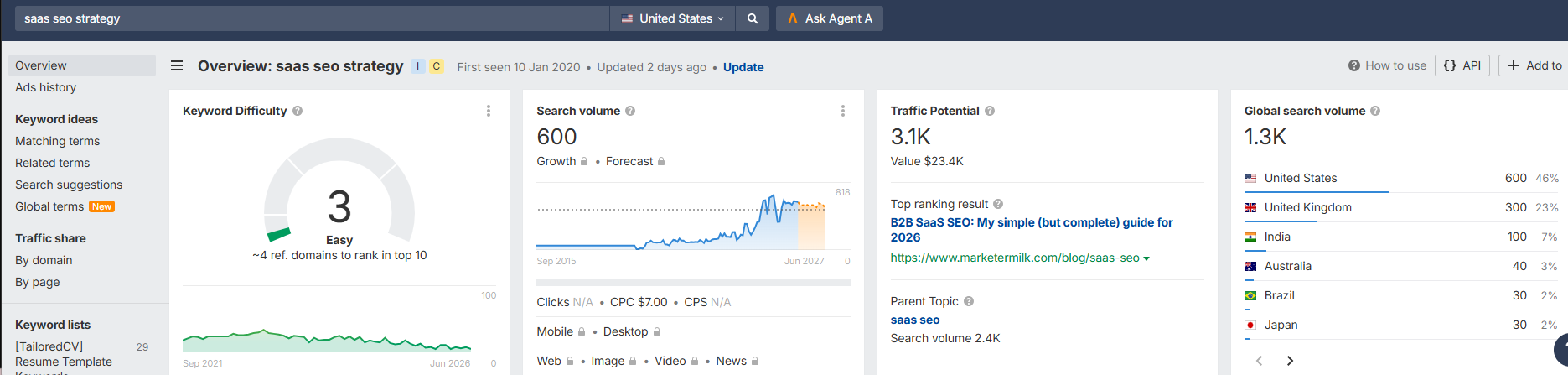
Choose your favorite tools, like Ahrefs or SEMRush, or even use Google Keyword Planner to find the top SaaS keywords for your company. Carefully monitor data such as keyword difficulty, search volume, traffic potential, etc.
Ideally, you’ll need to spot the ones with lower competition but large traffic potential. Start with a seed keyword, i.e., the one your target audience would use to start a search journey and find a solution like yours.
Besides short-tail keywords, don’t forget to consider long-tail queries too, as they are the exact phrases your target audience uses to find your service or product.
Tip: If you don’t have access to paid keyword research tools, you can leverage the free ones, like Ahrefs Keyword Generator.
2. Include Semantic Keywords
Use the previously mentioned keyword tools (or the ones you prefer) to find even more variations of your seed keyword, adding the unique values of your product.
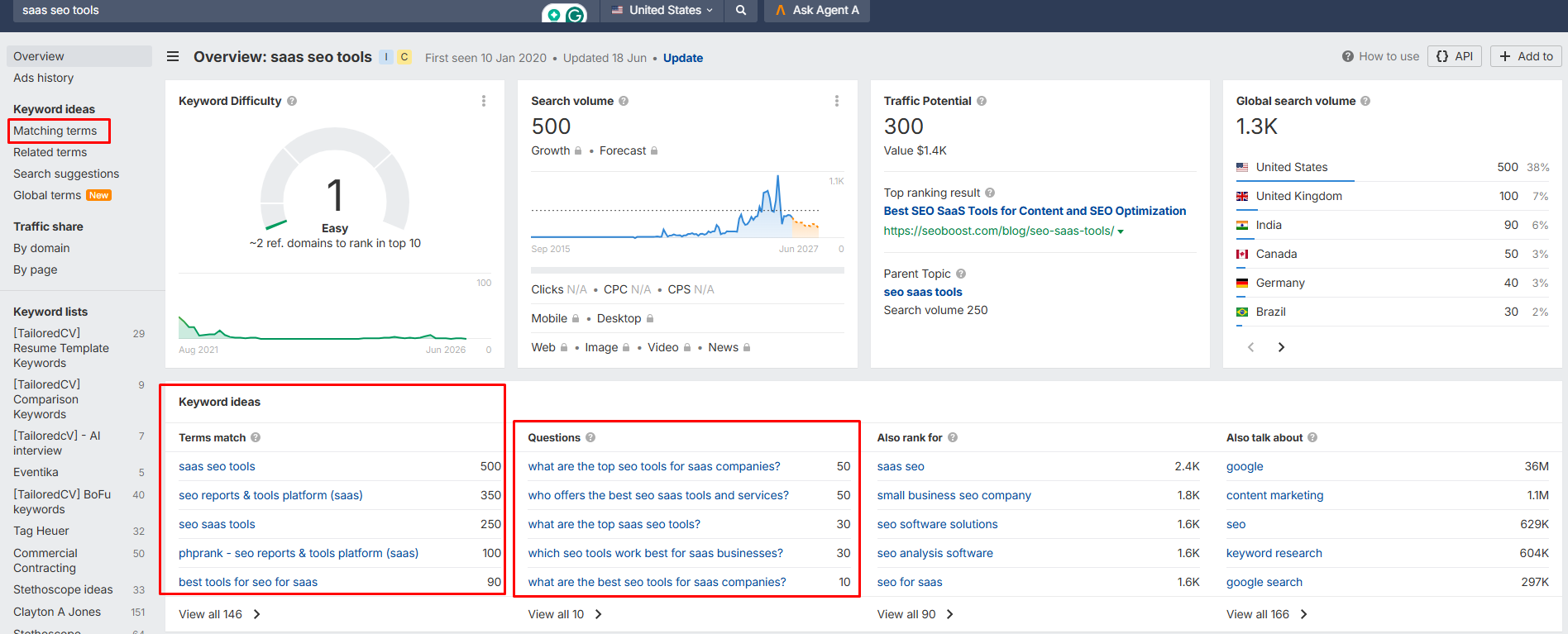
For example, we use Ahrefs to find semantic keywords.
You can see that there are a lot of matching terms you can use for your keyword research and choose as a target keyword. Filter them according to your DR and the possibility of ranking for the one you will choose.
Targeting long-tail keywords often results in low search volume, which makes them less competitive and easier to rank for. While fewer people are searching for them, they are considered high-intent keywords, making them easier to convert into qualified leads or customers.
3. Analyze Your Competitors
SaaS keyword research doesn’t stop at building a seed list. The next step is to refine it by carefully conducting SaaS competitive analysis, what your competitors are already ranking for, and where they’re falling short.
Look at their top-performing pages and the keywords driving traffic, but don’t stop there. Pay attention to what they’re not targeting. Those gaps often reveal untapped opportunities your own strategy can take advantage of.
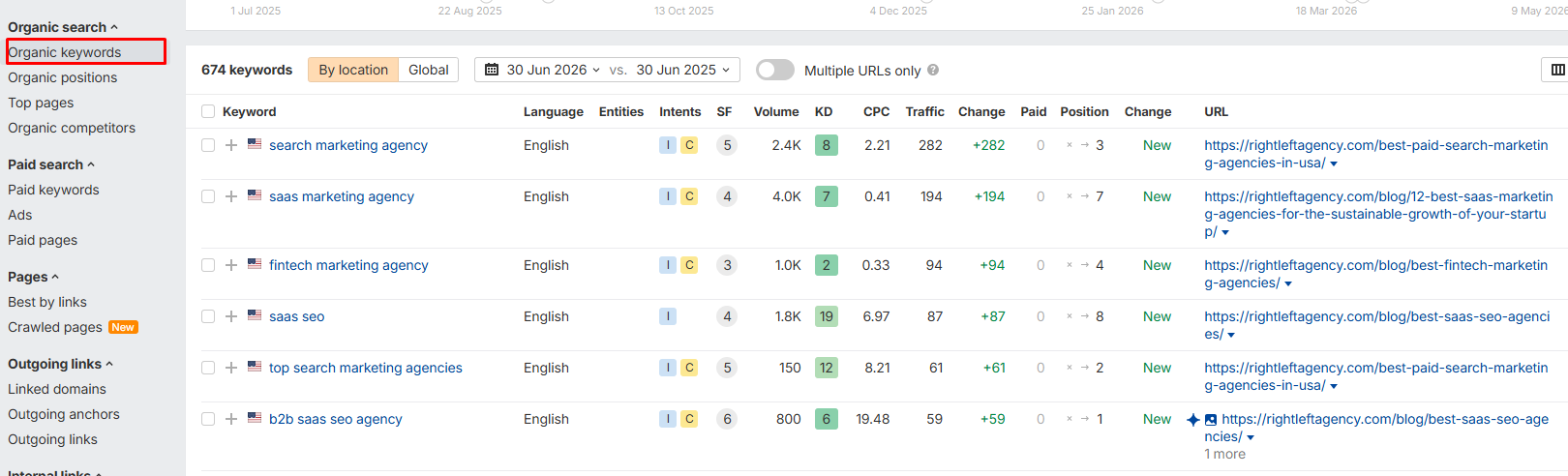
For example, in Ahrefs, you can identify their top-ranking pages and organic keywords they already rank for. Type the URL of your competitor, and from the left-side bar, choose the “organic keywords” tab. You will get a list of many keywords your competitor ranks for, along with their pages.
You can use the filters to sort them by keyword difficulty, non-branded queries, traffic, and more.
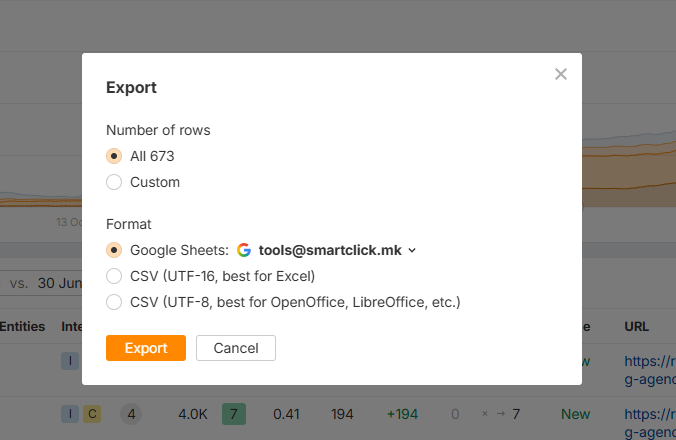
When you finish your analysis, you can export and download the data as a CSV file and continue the research there.
By identifying both their strengths and blind spots, you can shape a more focused and competitive keyword strategy. Competitor analysis remains one of the most effective and enduring SEO practices across the SaaS industry.
4. Cluster Keywords for Topical Authority
After you download the file, remove duplicates and irrelevant keywords, as well as those that don’t align with your content strategies and/or target audience.
Next, group related keywords into clusters based on search intent and topic. Instead of creating separate pages for every keyword variation, build comprehensive content around a primary keyword and naturally include closely related terms.
This helps search engines understand that your content covers the topic in depth, rather than focusing on a single keyword.
For example, if your primary keyword is “CRM software,” related terms that can belong to the same cluster can be :
“customer relationship management software”
“CRM for small businesses”
“best CRM tools”
Keyword clustering also helps you plan your site architecture, build stronger internal links, and avoid keyword cannibalization. Checking for potential keyword cannibalization in your keyword research process is crucial to ensure you’re not starting your strategy on the wrong foot.
There are multiple ways to check for that, all of which are thoroughly described in this keyword cannibalization guide.
5. Monitor the Performance
Keyword analysis for SaaS includes tracking keyword rankings over time to measure the impact of your keyword research efforts.
Set key performance indicators, i.e., important metrics, and check how it goes in the period after implementation. Once you optimize for the relevant keywords, it may take some time until the results show up.
Analyze metrics such as organic traffic, time on page, bounce rate, and conversions to assess how well your content satisfies user intent.
What Are the Best Tools for Keyword Analysis for SaaS
The best SaaS SEO tools for keyword research are:
Ahrefs
SEMRush
Google Keyword Planner
Ahrefs Keyword Generator (free option)
Keep in mind that these tools can help you in the actual keyword research process, while you need to do the search intent manually.
Always analyze the SERP to make sure you are targeting the right keyword intent. Check the top-performing pages, their content, and the keywords they use in the meta tags, headings, and throughout the body.
In addition, review the current clients and all the communication you have with them. Pay attention to their feedback and reviews, so you can get a fantastic insight into your Voice of Customers (VoC).
Additionally, explore the target audience and their behavior online. Find them on threads like Reddit or Quora, or niche-specific forums.
Keep in mind that this step is not a direct keyword research, but a method to refine your keyword list and find a connection between all those results you found.
Why SaaS Keyword Research Matters
While SaaS SEO doesn’t rely on keywords only, it’s essential to start with them. The described keyword research process will lead you to the exact pain points and customer questions you can resolve with your SaaS product. It also helps you:
Understand the Target Audience: Detect their specific needs and answer them through blog posts, service pages, CTAs, user manuals, or by offering the SaaS solution.
Driving Targeted Traffic: By optimizing for relevant SaaS keywords, you drive relevant traffic only while repelling the irrelevant ones, making your SEO strategy focused only on organic visitors who are actively searching for solutions like yours.
Improved Lead Quality: Targeted traffic easily turns into quality leads who are more and more interested in your SaaS product and very likely to convert at some point.
SaaS keyword research is a fundamental component of a successful digital marketing strategy – not only SEO. It provides the foundation for improving organic visibility, understanding customer needs, and ultimately driving business growth in the competitive SaaS marketplace.
The in-depth research for an existing SaaS company will recover the SEO ranking drops and help the SaaS companies get the deserved attention and visibility.
Conclusion
SaaS keyword research is an ongoing process that requires a lot of dedication, analyzing, and optimizing. While the ultimate goal is to find the top SaaS keywords relevant to your business, you shouldn’t forget about elements like buyer journey and search intent. That way, you won’t overwhelm your content with duplicate and irrelevant keywords. If you need help, book a free consultation, and our experts will guide you with a tailored SEO strategy with relevant niche keywords that will target your audience.
FAQs
How to find keywords for SaaS SEO?
Start with your seed keyword related to your product or service. Use keyword research tools like Ahrefs or Google Keyword Planner to discover related terms. Analyze your competitors to identify gaps and opportunities for your keyword strategy. Group the keywords by search intent and topic, and start writing. Always monitor the performance.
What are the best keywords for SaaS?
The best SaaS keywords are those with high relevance to your product, clear search intent, and a balance of search volume and ranking difficulty. Long-tail and SaaS-related keywords often deliver the best results.
How can ICP-relevant keyword research for SaaS help me in my content strategy?
Incorporating ICP (Ideal Customer Profile) and excluding anti-ICP keywords in SaaS SEO ensures your content targets high-value prospects while filtering out irrelevant traffic. This means targeting keywords that actually answer your ICP’s pain points.
How often do I need to optimize my keyword research SaaS strategy?
Review and update your keyword strategy at least every quarter. However, monitor keyword performance monthly to identify ranking changes, emerging trends, and new opportunities.
Let’s Solve Your SEO Challenges and Bring You Traffic That Converts
Book a free consultation today to learn how we can help you attract more of the right traffic and turn it into qualified leads for steady growth.