Listen to the audio version of this article (generated by AI).
You have probably created enough landing pages, but face the same issue: traffic is slowly growing, but still, no leads or conversions. Maybe the problem is not in creating more of them. On the contrary, more pages don’t mean higher rankings or getting more qualified leads.
Many companies face the same problem repeatedly. And if you ask yourself, “Why aren’t these visitors converting?” the answer simply is not about your content strategy. You need to optimize your exciting landing pages to start seeing results.
So before planning your next blogs, let’s first focus on these SaaS landing pages best practices that actually move the needle.
The Real Conversion Problem (It’s Not Traffic)
Converting the traffic is where most SaaS companies struggle. This is where your value proposition becomes critical. It should immediately answer: What do you do, who is it for, and why should I care right now? If someone lands on your page and doesn’t get an immediate answer, they will probably leave fast.
The next step isn’t focusing on more content. It’s fixing the landing pages around a clear framework.
Once that foundation is in place, make sure each page targets the right keywords as part of your SEO funnel strategy. Use high-intent keywords, especially commercial or transactional ones, for landing pages designed to convert them.
The 4C Framework for High-Converting SaaS Landing Pages
The best SaaS landing pages follow a simple model:
C
Goal
Landing Page Section
Clarity
Help visitors understand what your product does and who it is for within seconds.
Hero Section
Credibility
Build trust through customer reviews, case studies, ratings, and client logos.
Social Proof & Testimonials
Conversion
Encourage visitors to take the desired action, such as starting a free trial or booking a demo.
CTA Section
Convenience
Make it easy for users to find information, navigate the page, and convert without friction.
Navigation, FAQ & UX Sections
Every section of your page should serve one of these four goals. Let’s break down what that looks like in practice.
If you’re looking for inspiration, these successful SaaS content marketing examples that convert can show how leading companies apply similar principles across their marketing funnels.
1. Nail the Hero Section (You Have 5 Seconds)
At its core, your SaaS landing page should communicate a clear value proposition: what you offer, who it’s for, and the outcome users can expect. Therefore, the hero sits “above the fold” because it’s the first thing visitors see and needs to catch attention and provide real value before they scroll down.
Think of it as a 5-second test: if a visitor immediately understands what your page is about, who it is for, and why it matters, then you are on the right path.
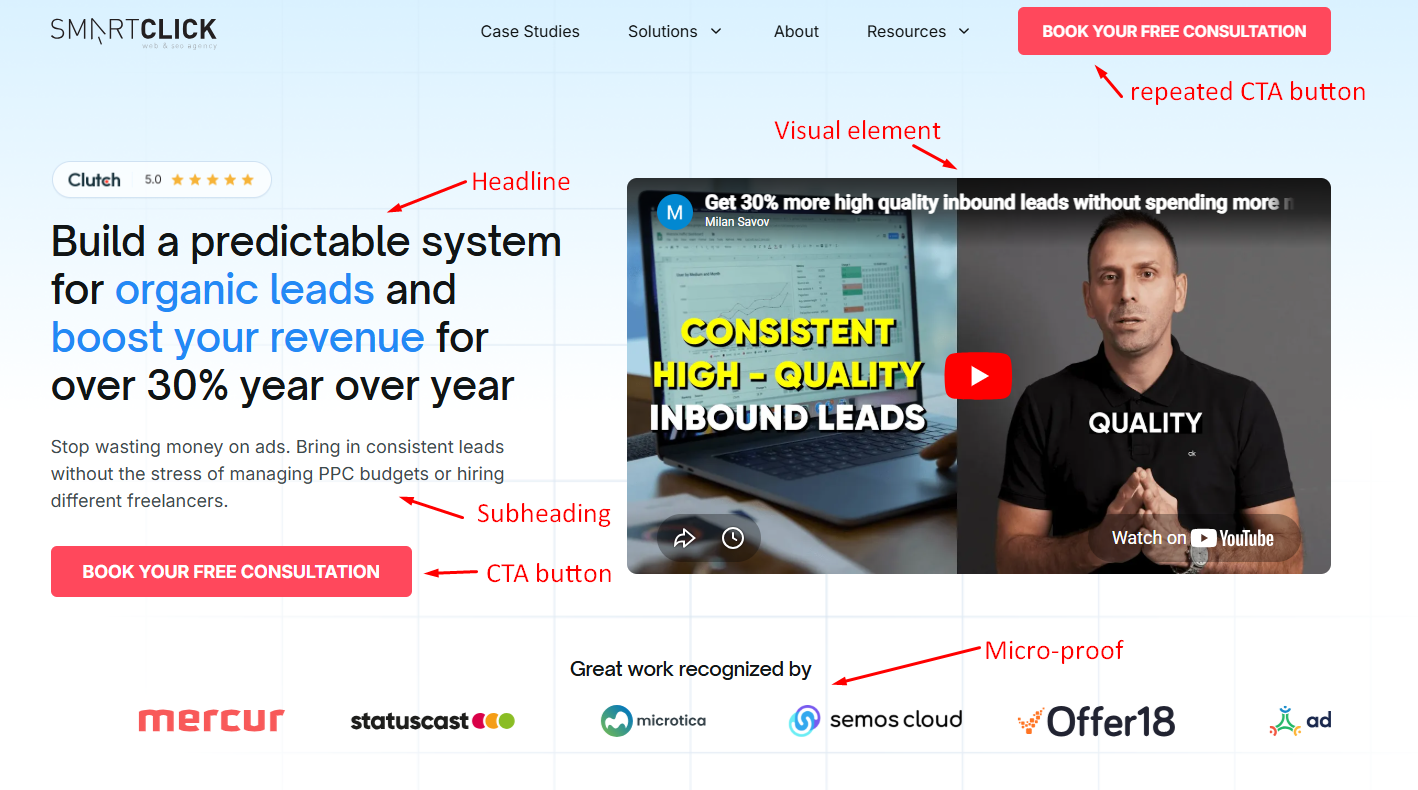
For SaaS, a great SaaS hero section includes:
A clear headline: A two-line short description that delivers the benefit of your service or product.
A subheading: This is the bridge between understanding and relevance. The subheading explains who it’s for and what the problem solves.
A visual element: Show your actual interface to visually explain what your product does.
A strong CTA button: A clear “Book a demo,” “Start your free trial,” “Book a consultation”. The verb should tell users what they’ll get. And repeat it consistently throughout the page.
A micro-proof: This is placed near the CTA and includes recognizable customer logos, s imple “Trusted” badge, and similar proof that adds credibility and trust for visitors.
2. Show How It Works (Don’t Just List Features)
Next, show how your service/product works. Avoid just listing the key features without showing how they can fit in the visitor’s workday.
Organize your features into a3–5 simple steps that mirror what your customer already does.
Here are clean “How It Works” flow structures you can use for SaaS/service pages:
Example – Service/Agency Model
Discover – Understand client needs and goals We audit current performance and define objectives.
Plan – Build a clear execution roadmap We outline strategy, timeline, and deliverables.
Execute – Deliver the actual work We implement campaigns, fixes, or services.
Report – Show results and next steps We provide insights, performance data, and optimization plans.
3. Build Credibility with Social Proof
Once a visitor understands your product, they look for proof that it works for people like them. This is where social proof comes in. But not all social proof is created equal.
What actually works for SaaS:
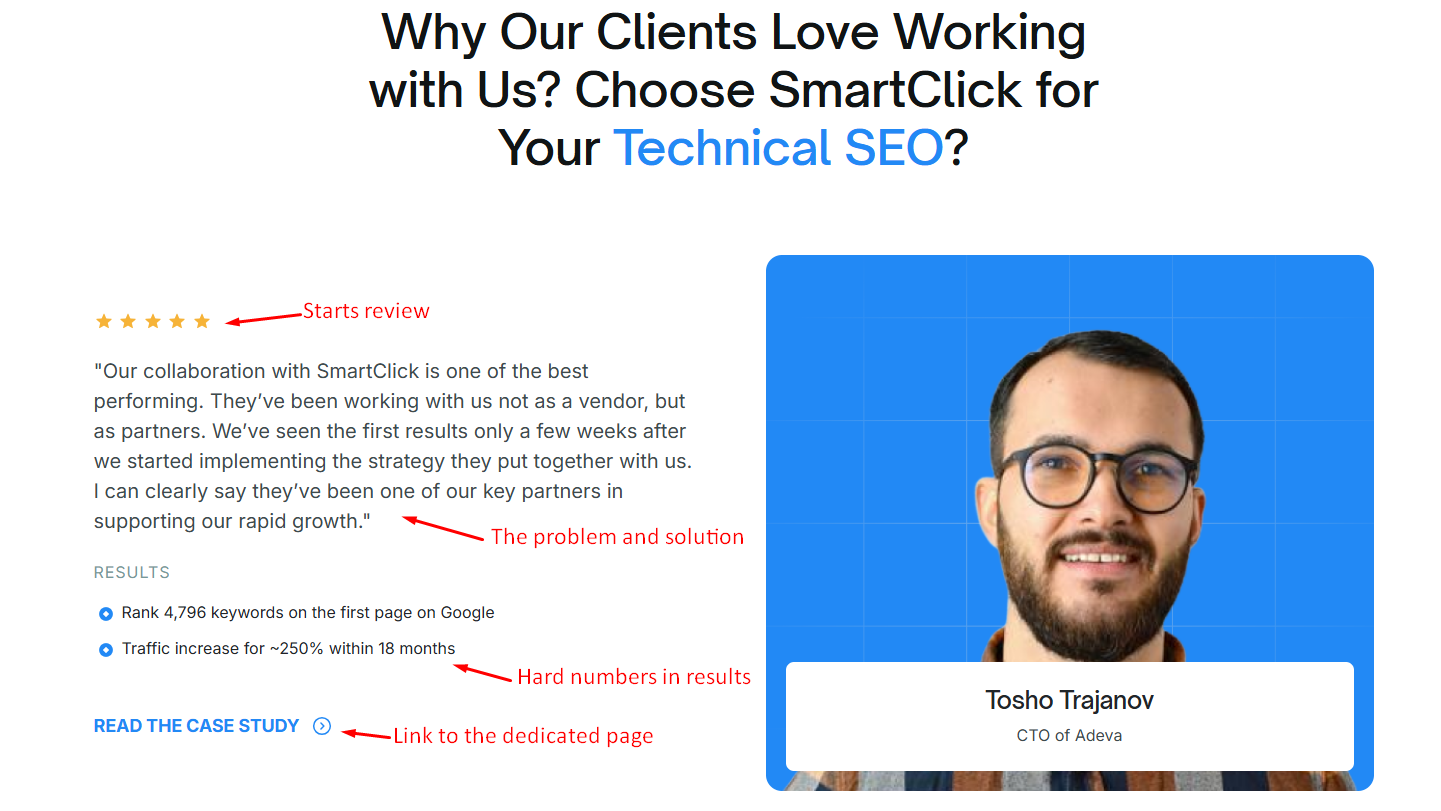
Case studies: Link to 1-3 customer stories. Keep it simple: problem, solution, and the result. And then link to the full story dedicated page if a visitor wants to go deeper.
Testimonials: Use 1-2 strong, specific quotes with real names, job titles, and company names. The most effective ones usually show a clear before vs after.
Review badges: Logos from platforms like Clutch, Capterra, or TrustRadius work best when placed close to your CTA. They add instant trust without needing long explanations or anonymous praise.
Hard numbers: Be specific and concrete. Things like “3x faster setup,” “1M+ employees onboarded,” or “$2.5M in annual savings” land much better than vague claims like “industry-leading” or “best-in-class.”
Here’s an example of our technical SEO landing page, offering all the important sections, plus the social proof part.
4. Don’t Forget the FAQ Section
The FAQs section is not a big win just for SEO, but for AI tools like AI Overview, ChatGPT, Perplexity, and other search engines that are increasingly pulling information from the well-structured Q&A content. They’re designed to respond to real questions users actually ask.
For SaaS landing pages, focus your FAQ section on the questions that increase conversion, including:
How does pricing work?
Does it integrate with our stack?
How long does setup take?
How is our data secured?
What’s your onboarding process?
How often do you make reports?
What does support look like?
Answer with 1-2 direct and concise sentences in a conversational way. This also helps LLMs extract information from your questions and present it as a response when someone asks about your service or product.
Do your research. Look in places where users naturally reveal confusion or intent:
Sales calls and demos
Support lice chat
People Also Ask (PAA)
Forums like Reddit and Quora
LinkedIn profiles
Competitor pages
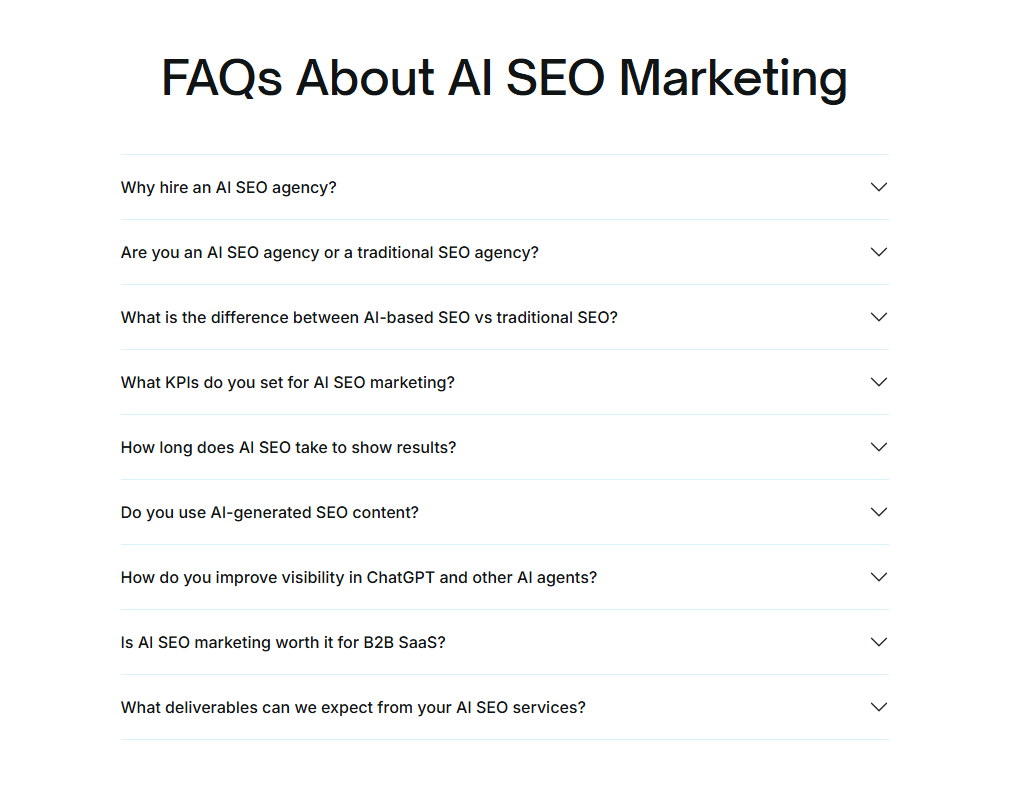
For example, in our AI SEO services, we include these FAQs based on the most common questions users actually ask during research and evaluation:
5. The Final CTA
By the time a visitor reaches the bottom of your page, they’ve seen your hero, understood your product, and reviewed your proof. Now they need some time to take the final move.
This is where your primary CTA button needs to appear. When they see the same phrasing, it feels familiar and reduces friction.
However, not everyone is ready to buy right now. As part of their journey, give them a lighter next step to keep them in your circle without forcing them to commit.
That could be a link to:
A short case study with clear outcomes
A relevant blog post or guide
A whitepaper that helps justify the investment internally
For example, we added an additional section that guides visitors to see more results from our case studies before they take the final step.
6. The Technical SEO Foundation
Don’t forget about the technical issues you need to fix before going live. These aspects are as important as the whole content structure. You can create the best landing page with every necessary section, but if the design is broken or the page doesn’t load, it won’t work.
Therefore, pay attention to:
Page speed: How fast your pages load matters more than most people think. Even a small delay can hurt conversions because users don’t wait; they leave. Check your page speed using PageSpeed Insights.
Mobile responsiveness:According to a 2025 study, 53% of mobile users abandon a site if it takes longer than 3 seconds to load. So mobile-first is no longer optional.
UX design:Based on a LinkedIn study, a 1-second delay can reduce conversions by up to 7%. Low color contrast, missing alt text on images, and similar issues may significantly impact your landing page.
Schema markup: This is how you help search engines actually understand your SaaS product. By using Product, Review, and FAQ schema where relevant, you make it easier for Google to interpret what your product does, who it’s for, and why it’s relevant.
Build SaaS Landing Pages with SmartCLick
This process doesn’t have to be overwhelming. Improving your rankings and conversions doesn’t mean creating more content or adding more key sections to your exciting landing page. When your message, layout, and flow are structured properly, you tell a story that guides the visitor naturally towards action. That’s where these SaaS landing page best practices can help you.
Also, SmartClick helps you build exactly that: landing pages that are simple, strategic, and designed around how users actually think and decide. From clarity in your value proposition to strong proof and a strong technical foundation, the result is a landing page that performs well.
FAQs
What are the SaaS landing page trends for 2026?
The biggest SaaS landing page trends in 2026 are centered around clarity, trust, and AI visibility. They are focusing on clear value propositions, simple product stories, and stronger social proof.
Does a really good landing page actually make users pay sooner?
Yes, because a well-structured SaaS landing page delivers clarity, quickly explains what your product does, who it’s for, how it works, and why it’s worth the investment. So, a qualified visitor will naturally take an action, like booking a free consultation, requesting a free demo, etc.
What are the most crucial sections of a SaaS landing page?
The most important sections of a SaaS landing page are the hero section, product features, social proof, FAQs, a final strong CTA, and a technical SEO foundation.
Let’s Solve Your SEO Challenges and Bring You Traffic That Converts
Book a free consultation today to learn how we can help you attract more of the right traffic and turn it into qualified leads for steady growth.