Listen to the audio version of this article (generated by AI).
Authoritative content is important for building credibility and trust. Search engines like Google and AI tools favor high-quality content, which improves your rankings, traffic, and AI visibility.
Why build authoritative content? Simple answer: it is the best way to stand out in the competitive SaaS market.
Most SaaS blogs publish content. Very few publish content that ranks, converts, and gets cited.
In this blog, we will look at the best strategies to build authoritative content, why it is important for your SaaS business, and common mistakes to avoid.
What Is Authoritative Content?
Authoritative content is well-researched, unique, and comprehensive content that provides meaningful information to readers about a specific topic.
Creating authority content means including:
In-depth analysis from unique perspectives
A niche expertise
Backed up by credible sources
Covers user intent thoroughly
Provides actionable insights
Covers all SEO elements
For example, a 500-word blog post is rarely considered authoritative on a complex topic. In contrast, a 2,000+ word guide that includes original research, valuable data, real-world case studies, expert insights, and comprehensive coverage of the subject is far more likely to be seen as authoritative by both readers and search engines.
This does not mean that quantity matters more than quality. A short article can still be highly valuable if it fully answers a specific question or addresses a narrow topic in depth.
However, when covering broad or competitive SaaS subjects, longer content often provides the space needed to demonstrate expertise, deliver comprehensive information, and satisfy user intent more effectively.
Authoritative Content vs. AI-Generated Content: Where SaaS Brands Fail
The debate between authoritative content and AI-generated content is where many SaaS businesses struggle.
AI made the content creation process much faster because it can create outlines, draft articles, summarize research, and more, within seconds. However, AI alone can’t provide authoritative content.
Why?
Authoritative content requires experience, expertise, deep understanding of the subject matter that AI alone cannot produce. And this is what your SaaS brand needs to rank higher and get cited.
AI can help you create content faster, but only human expertise can make that content authoritative.
Why Build Authoritative Content: The 6 Core Reasons for SaaS
Let’s take a look at why building authoritative content is important for your SaaS presence.
Builds Trusts
If you constantly deliver updated, high-quality content, you will:
Position your brand as an industry leader
Building trust among your audience
Signals search engines that you are constantly active and align with new trends
In SaaS, trust reduces the sales cycles, as buyers don’t spend months verifying claims or seeking external validation.
Improves Rankings
Google and AI search engines favor depth. A full guide content that covers every aspect of the topic improves your rankings because:
When you constantly publish authoritative content, it signals search engines like Google and modern AI systems that you are an expert in your niche. This is called topical authority.
Establishing your SaaS brand as an authority in the field will help you:
Authoritative content tends to generate more engagement, including shares, comments, and backlinks.
Why?
Other websites like to link to detailed, original content. Backlinks earned from authoritative sources accumulate and strengthen over time, unlike paid links.
When users find your content relevant, reliable, and written by an expert, they are more likely to:
Sign up for a demo or free consultation
Subsribe for a newsletter
Share your content
Become a buyer
This improves the opportunity to turn your passive traffic into more qualified SaaS leads and increase revenue.
Powers Lead Generation Funnel
Valuable content attracts customers, and this can be used as an effective tool for SEO lead generation.
One strong, authoritative post can be reusable across your entire SaaS growth engine. It can fuel your newsletters, get repurposed into social content, support your sales team, and even be used in blog post outreach or partnerships.
How to Create Authoritative Content for Your SaaS
Let’s break down exactly how to build authoritative content that earns rankings, trust, and compounding growth for your SaaS brand.
1. Own a Focused Topic, Not Everything
Authority doesn’t mean publishing more content. It starts with knowing you have something more to say.
Before writing anything, ask yourself: what does your SaaS genuinely understand better than anyone else?
Your buyers aren’t looking for random blogs. They search for:
So, when your brand consistently shows up across these pages, your SaaS naturally becomes the one people trust. But that doesn’t happen if you stay at the surface level. Instead, go deeper.
Start expanding around the core problem your product solves, and build a connected set of topics that fully support it.
For SaaS content, start by picking two or three core topic clusters about your product or service and cover major problems, related workflows, comparisons, and implementations that will show you fully own the topic.
2. Build Authority Signals
E-E-A-T for SaaS, Experience, Expertise, Authoritativeness, and Trust, is what search engines use to decide whether your SaaS content is credible enough to rank, and whether it deserves to be generated in AI-driven answers as well.
For SaaS brands, authority isn’t just about publishing content. It’s about proving you are an expert in your niche.
That means strengthening visible trust signals across your site, such as:
Showing real authorship behind your content
Backing claims with case studies, customer results
Earning mentions and backlinks from credible sources
Clearly communicating who you are, what you’ve built, and why your insights should be trusted
Making your product and company information transparent
When these signals are consistent across your website, Google and AI systems start to treat your SaaS as a reliable entity.
3. Write Depth-First, Not Length-First
A lot of SaaS content is long. Very little of it is actually deep.
There is a real difference between the two.
Long content hits a word count. Deep content:
Anticipates your reader’s next question before they ask it
Addresses objections buyers already have in their heads
Connects the concept to a real business outcome
Leaves them with something meaningful they won’t find elsewhere
Depth is what makes the content worth citing, sharing, or linking to.
4. Structure Your Content for Humans and Search Engines
If your content is not structured properly, search engines won’t understand it, which directly impacts your ranking.
Put yourself in the shoes of your customer. If you visit your page and can’t understand what it’s about, why it matters, and how it will solve your problems, you will probably leave sooner.
For SEO for SaaS, to make your content authoritative, you need to pay attention to these key factors:
Place your target keyword in the first 100 words and in one of the H2s
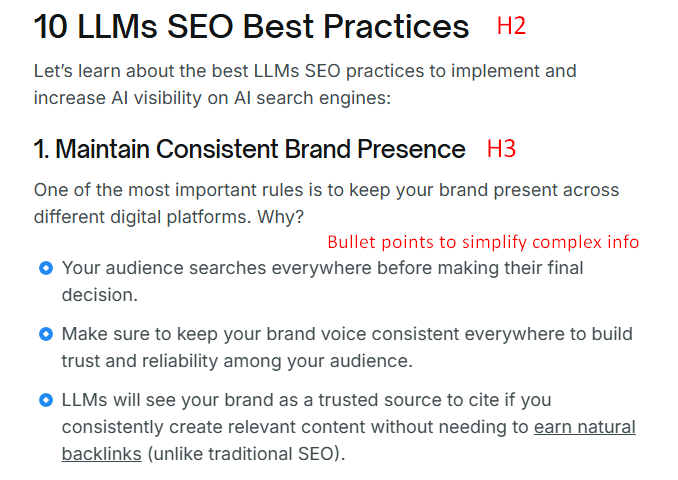
Use proper heading structure, including H2s, and H3s to answer specific sub-questions
Add an FAQ section with schema markup
For readability:
Keep paragraphs to 2–4 sentences maximum
Use bullet points to explain complex information
Add visuals to simplify your content
Write in a clear, conversational tone
Your buyers tend to trust pages that write content in a more natural and conversational way. Just the way they search on ChatGPT, Perplexity, Claude, and other LLMs.
5. Build a Link Acquisition Strategy
When reputable sites link to your SaaS page, it signals Google that your brand is a trusted source in your category. The same is for your customers – they trust you as a reliable source of information.
Your strongest link magnets as a SaaS brand are:
Original research reports
Comprehensive ultimate guides
Free tools, calculators, or templates your audience actually uses
Visual frameworks, comparison charts, or process diagrams
6. Earn Referral Traffic from Credible Sources
Linked SEO brand mentions are a powerful source of high-quality referral traffic. When a user comes across your brand mention in a blog post or article and clicks the link to learn more, that traffic is directly attributed to the brand mention.
The users usually show up more interested. They’re already curious, which means they’re more likely to explore, spend time on your pages, and eventually take action.
Implementing all these strategies above will help you earn backlinks more naturally.
7. Refresh and Update Your Content
Publishing more content won’t earn a high ranking and trust. Sometimes you need to take a look at your old content and make some improvements.
Regularly analyze your underperforming pages to identify common gaps and opportunities to improve.
For example, a guide published 18 months ago probably includes:
Tools that are shut down
Old pricing models
Outdated statistics
Outdated features
Google notices this as well as your readers.
Perform a content audit and prioritize low-quality content. For each one, ask:
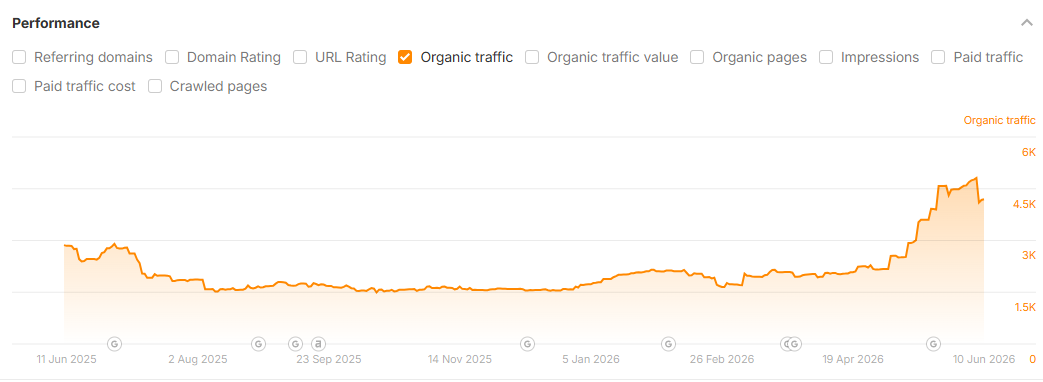
We refreshed the content for our client, and here are the results in Ahrefs.
As you can see, over the following months, organic traffic grew consistently.
Real-World SaaS Examples of Authoritative Content Done Right
The best way to understand what authoritative content looks like in practice is to study the brands already doing it exceptionally well.
HubSpot
HubSpot sells marketing and CRM software.
HubSpot built authority by becoming the most comprehensive free resource in its category:
Their blogs cover every marketing, customer, and sales topic their buyers search for.
Their free tools, templates, and certifications deliver value before the sale.
The result: Their content attracts millions of visitors every month, making it widely authoritative in their niche.
Ahrefs
Ahrefs sells an SEO tool.
Their approach for building authority is:
Creating content with verifiable credentials and real-world experience.
The content demonstrates expertise – shows unique screenshots, data, and case studies.
The result: The creation of a content library that ranks for thousands of high-intent SEO keywords, which buyers trust even before signing up for a demo.
Gong
Gong sells revenue intelligence software.
Their authoritative content includes:
Updated statistics that journalists, sales leaders, and bloggers want to cite and share.
Insights from millions of real sales calls analyzed through their platform.
The result: A content asset that earns hundreds of backlinks per report.
As you can see, each brand targets a different audience and operates in different categories. Furthermore, they have a few things in common:
They focus on a topic around their product/service, not everything.
They use formats that only they can execute – their own data and expertise.
They treat content as a long-term strategy.
How to Measure the Impact of Authoritative Content for SaaS
You need to continuously track your SaaS SEO strategy and AI performance to maintain authority.
Here is what to measure:
SEO Metrics: Track keyword rankings for your industry, referring domains, and AI appearances. Use SEO tools like Ahrefs, or use GSC.
Pipeline Metrics: Monitor organic dignups, conversions, time on page, scroll depth, and bounce rate. Use GA4 for this.
Authority Signals: Watch for backlinks, citations in AI Overviews and LLMs, blog post outreach, and brand mentions.
Common Mistakes SaaS Brands Make When Building Content Authority
Through our work with different SaaS clients, we’ve noticed a common pattern: most brands want to build authority with content, but very few actually approach it in a way that compounds over time.
The most common mistakes our clients were making include:
Writing just to rank for keywords
Publishing content with no clear credibility signals
Not writing from their own perspective
Treating every blog post the same
Focusing on building backlinks without creating content
Only publishing, never updating old content
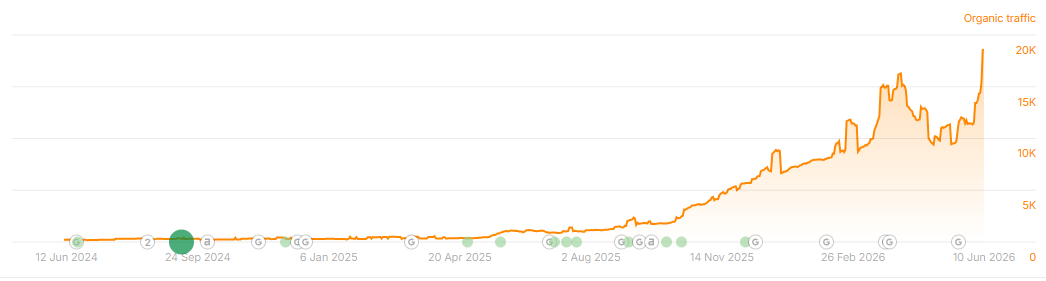
To fix these issues, we didn’t start by publishing new blogs. Instead, we focused on improving the existing ones, add unique perspective, updating outdated content, and fixing some technical issues.
Over time, not only did the content rank better, but it also continued to build authority, attract backlinks, and generate more organic traffic, as shown in the example below.
How SmartClick Helps in Builidng Authoritative Content
Why build authoritative content? The simple answer: for long-term trust, better rankings, more citations, and higher conversions.
We help SaaS brands create authoritative content that earns rankings, builds trust, and attracts natural backlinks.
We do this by building tailored SEO strategies that align closely with real user search intent, so every piece of content is designed to answer the right questions, at the right depth, for the right audience.
From there, we focus on creating content that actually stands out. Not generic articles. Not targeting only one keyword. Not publishing more blogs.
Quality, original content that strengthens trust. And trust builds authority.
FAQs
What is authoritative content in SEO?
Authoritative content in SEO is content that demonstrates expertise in the niche, provides accurate and trustworthy information, includes real-world examples, and is recognized as a reliable source on a specific topic.
Why is authoritative content important for SaaS?
Creating authoritative content is important for your SaaS business because it improves your rankings, builds trust with potential customers, earns more natural backlinks, and increases your brand’s credibility and trust.
How do I make my content more authoritative?
To make your content more authoritative, focus on writing in depth, using semantic keywords, using heading structure properly, including bullet points to simplify information, writing from your own perspective, and showcasing a deep understanding of the subject matter using real-world examples, screenshots, and results from your clients.
What is EEAT, and how does it relate to authoritative content?
EEAT stands for Experience, Expertise, Authoritativeness, and Trustworthiness. It’s a framework Google uses to evaluate content quality, and strong EEAT signals help establish your content as authoritative and trustworthy. Authoritative content naturally demonstrates strong EEAT signals, covering all the aspects mentioned above.
Let’s Solve Your SEO Challenges and Bring You Traffic That Converts
Book a free consultation today to learn how we can help you attract more of the right traffic and turn it into qualified leads for steady growth.