Listen to the audio version of this article (generated by AI).
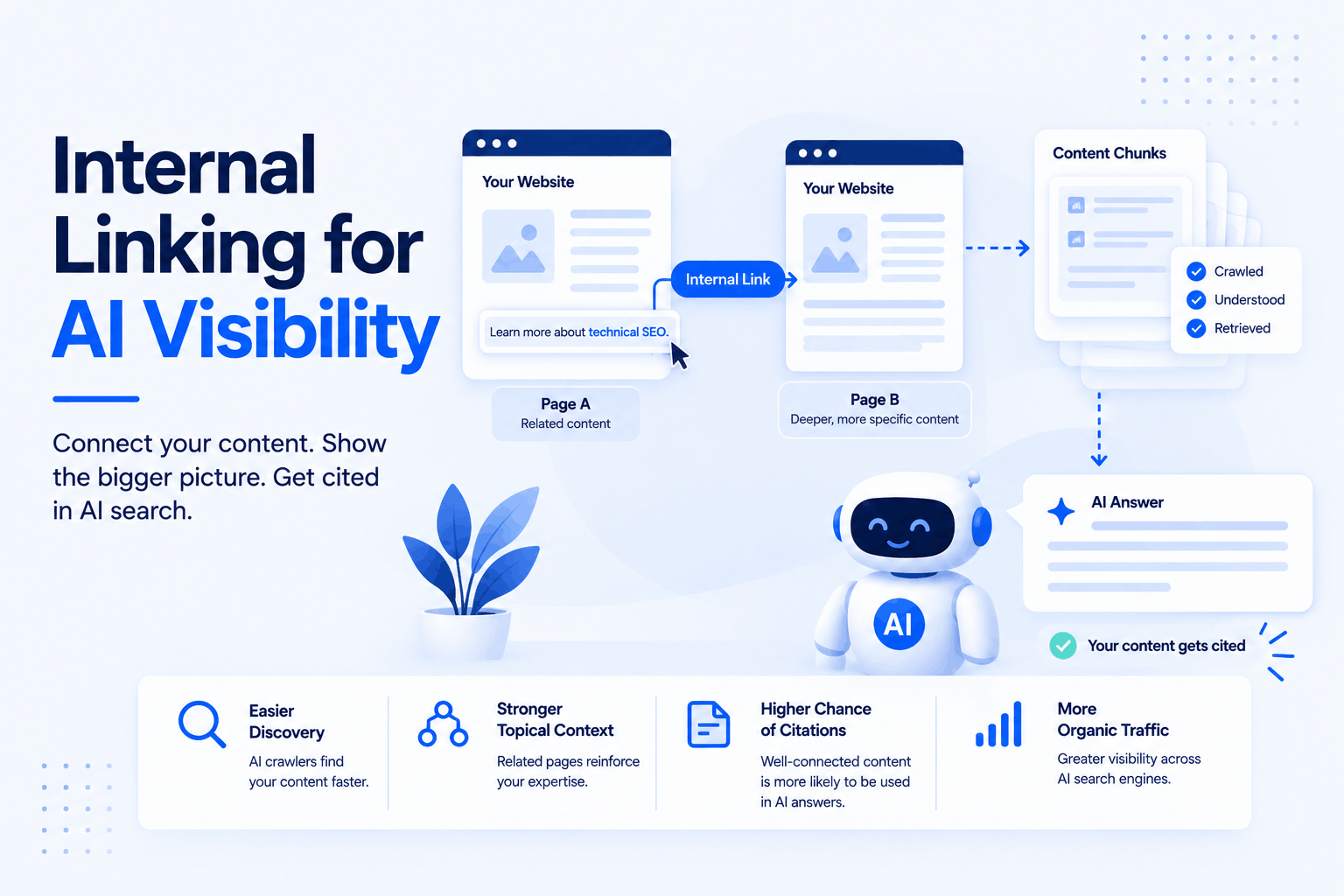
The way your pages connect is how AI maps what your site is about. Then it decides whether the content is actually worth pulling an answer from. So, AI here looks for contextual depth, not just checking if the anchor text matches the destination page’s title.
The way AI bots crawl internal links is different from the way traditional search engines do. This doesn’t mean you should avoid traditional internal linking – but to add a structure that helps AI models understand why the pages are connected.
Why Internal Linking Matters Differently for AI Search
Internal linking has always been a fundamental part of SEO strategy, but with AI, its role has shifted.
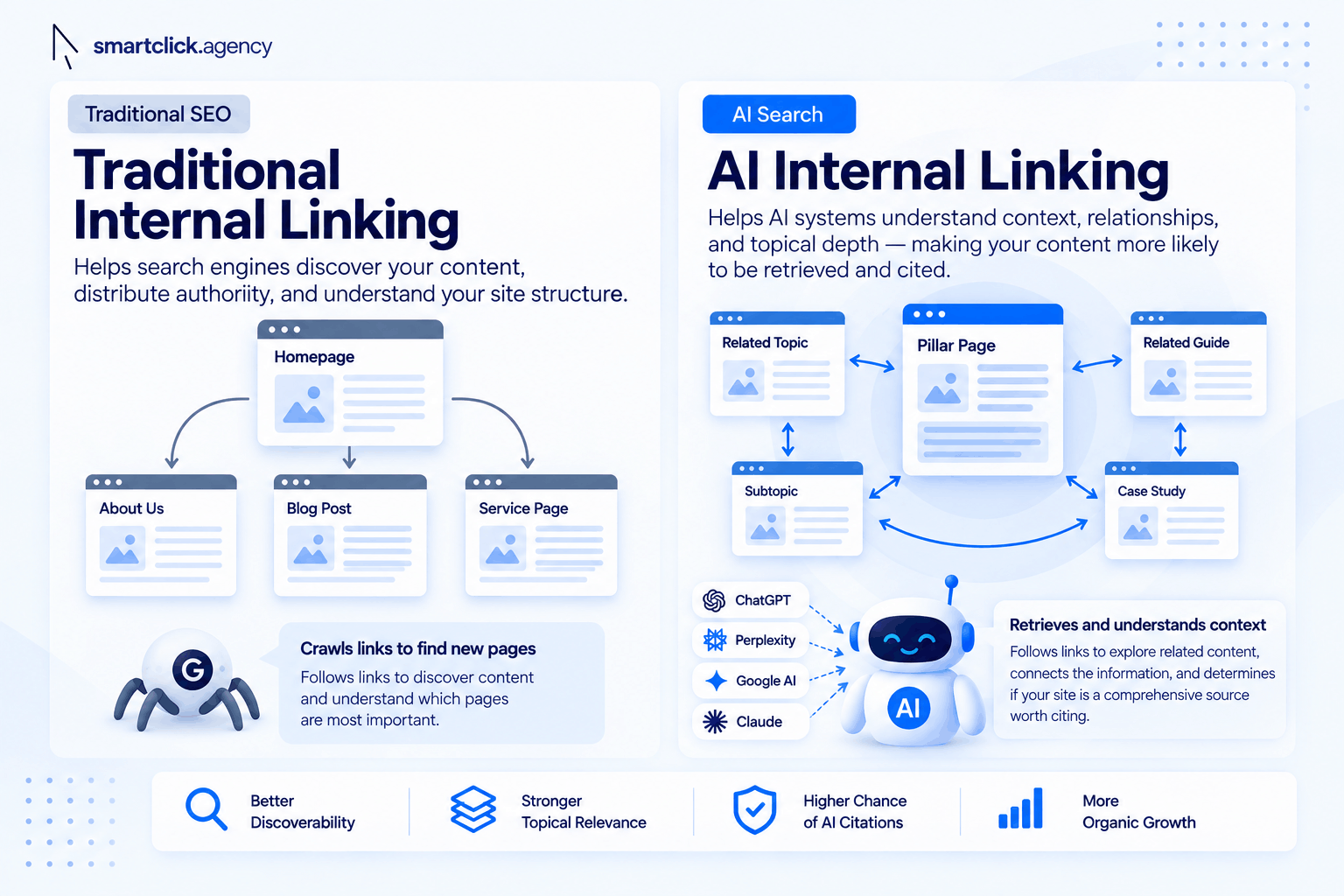
Traditional search engines use internal links primarily to distribute PageRank between pages, while AI retrieval systems like ChatGPT, Perplexity, AI Overviews, and others use the link to access the topical depth and decide whether the site is a credible and comprehensive source worth citing.
Many AI tools use a process called Retrieval-Augmented Generation (RAG). Instead of relying only on what the AI system learned during training (which means they don’t automatically have up-to-date information), RAG allows it to search for relevant information and retrieve that content from the web in real time to create a more accurate answer.
But these RAG crawlers have limited time exploring your site. If important content is difficult to find, slow to load, or buried deep within your site, it may be less likely to be retrieved and used in an answer.
This is exactly why your internal links matter: they’re part of what determines whether your pages get found and pulled into that search in the first place.
Why internal linking for AI visibility matters?
AI doesn’t read your whole page, it reads a “chunk” of it. This means your content is broken down into smaller pieces so AI systems can compare each piece to the search query and find a match.
AI tools favor topic clusters, not scattered pages. To generate a complete answer, AI systems often expand one question into several related sub-questions and search all of them at once. A method called query fan-out.
AI systems don’t rely on anchor text alone. They use the anchor text with the surrounding content and linked page to understand the relationship between the topics.
What does this mean for your page?
If your internal links don’t clearly connect related content across your site, it may be harder for AI systems to discover and connect the information they need.
Also, a proper site structure gives AI retrieval systems more context for how your content fits together. Therefore, use internal links with relevant anchor text not only to demonstrate topical depth on a subject, but to create topical clusters that AI models will use as proof of your expertise.
Traditional Internal Linking vs. AI Internal Linking
In traditional SEO, a page can still rank well even if its internal links come from pages that aren’t closely related to its topic. Google can still understand and evaluate those links.
AI retrieval systems don’t work that way. A page with just three internal links, but all from topically related pages within the same cluster, carries more weight than a page with ten linked from disconnected content.
Let’s explain this in simple terms.
Imagine traditional SEO internal linking as a roadmap for search engines. You connect related pages to help crawlers discover your content, understand your site structure, and identify which pages are most important.
Internal linking for AI visibility is a step further, where you connect pages so AI systems can better understand the context, relationships, and depth of your information. Not only helping them navigate your website.
So, the goal is to do a strong internal linking strategy that supports both.
How to Build an Internal Linking Strategy for AI Visibility
If you are trying to do a well-structured internal linking strategy, here are a few steps you need to follow:
Audit Your Current Site Structure
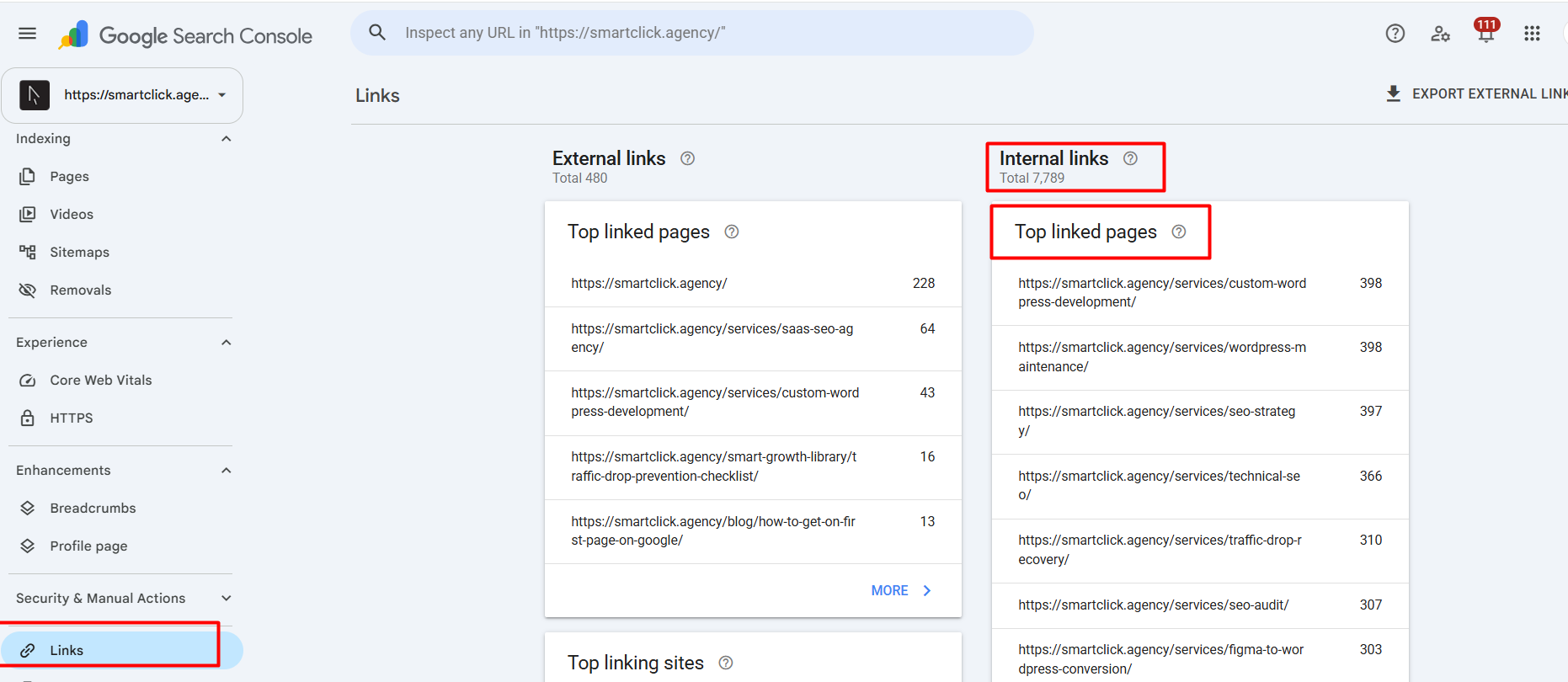
Start by analyzing your current internal linking strategy. In Google Search Console, you can see the Internal Links with the Top linked pages.
If you click more it’s going to open a list of all your internal links, the pages with the most links, and also the pages that are really missing out on those opportunities.
With these data, you can review your existing internal links and improve them if needed, and also focus on pages that have zero or low internal links.
For more accurate analysis, you can use a tool like Screaming Frog to find the orphan pages. These pages have zero or one internal link pointing to them, so they are completely invisible to AI systems no matter how great the content is.
Create Pillar Pages and Topic Clusters
These ones are the site architecture foundation.
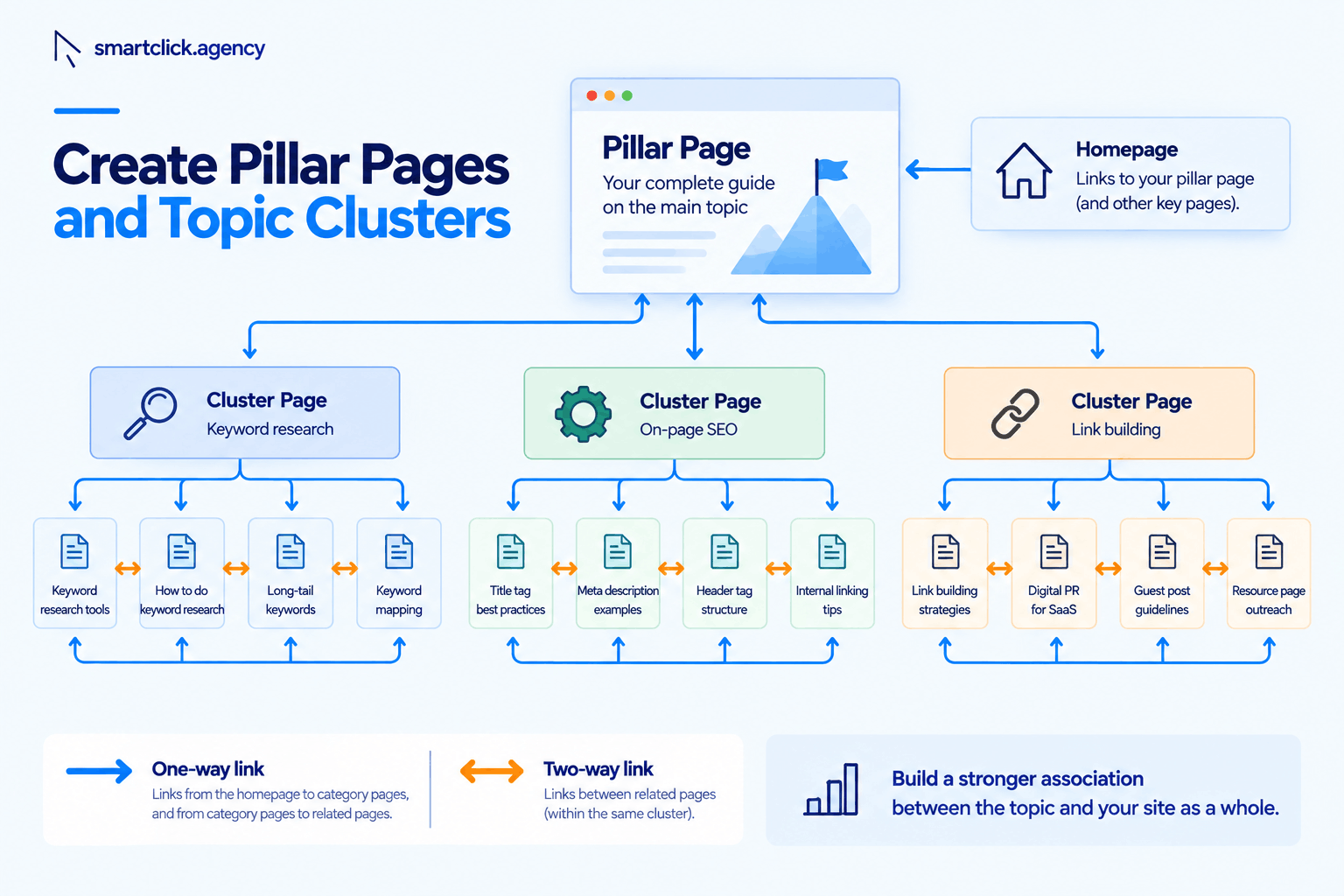
A pillar page covers a broad topic comprehensively. Supporting cluster pages are focused, in-depth blogs that each cover specific subtopics of that broader pillar page.
A well-structured pillar page SEO strategy for AI visibility connects your main topic with related cluster pages, making the content easier for AI systems to discover and understand.
Each cluster page links back to the pillar page, while the pillar page links to each cluster page. Cluster pages can also link to other closely related cluster pages, creating a well-connected topic cluster. And this matters for AI citations because it builds a stronger association between the topic and your site as a whole.
If you don’t have these yet, that’s your next move.
First, define your pillar topic. Analyze how users are searching for you and build the topics around that. Choose 2-3 core topics.
Once you’ve mapped your pillar topics, create the content that will connect them properly. These are the supporting, cluster pages, where every supporting page should link to the pillar, and the pillar should link to every supporting page.
Use descriptive anchor text that will tell Google and AI search engines how the two pages are related. Avoid generic anchors like “click here” that provide no semantic value between the pages.
Use Anchor Text as a Relevance Signal for AI Retrieval
When an AI model follows a link, the anchor text and the sentence wrapped around it are the main factors it uses to understand how those two pages are connected.
So, a generic anchor like “read more” or “more info” tells the model nothing at all.
But a descriptive anchor sitting inside a sentence that clearly explains what the destination page is about, it gives the model context to actually store that information and use it later to answer a question about that topic.
What we noticed when working with clients
When trying to improve the internal linking structure to strengthen AI visibility, we noticed that traditional anchor text doesn’t always reflect how people interact with AI search.
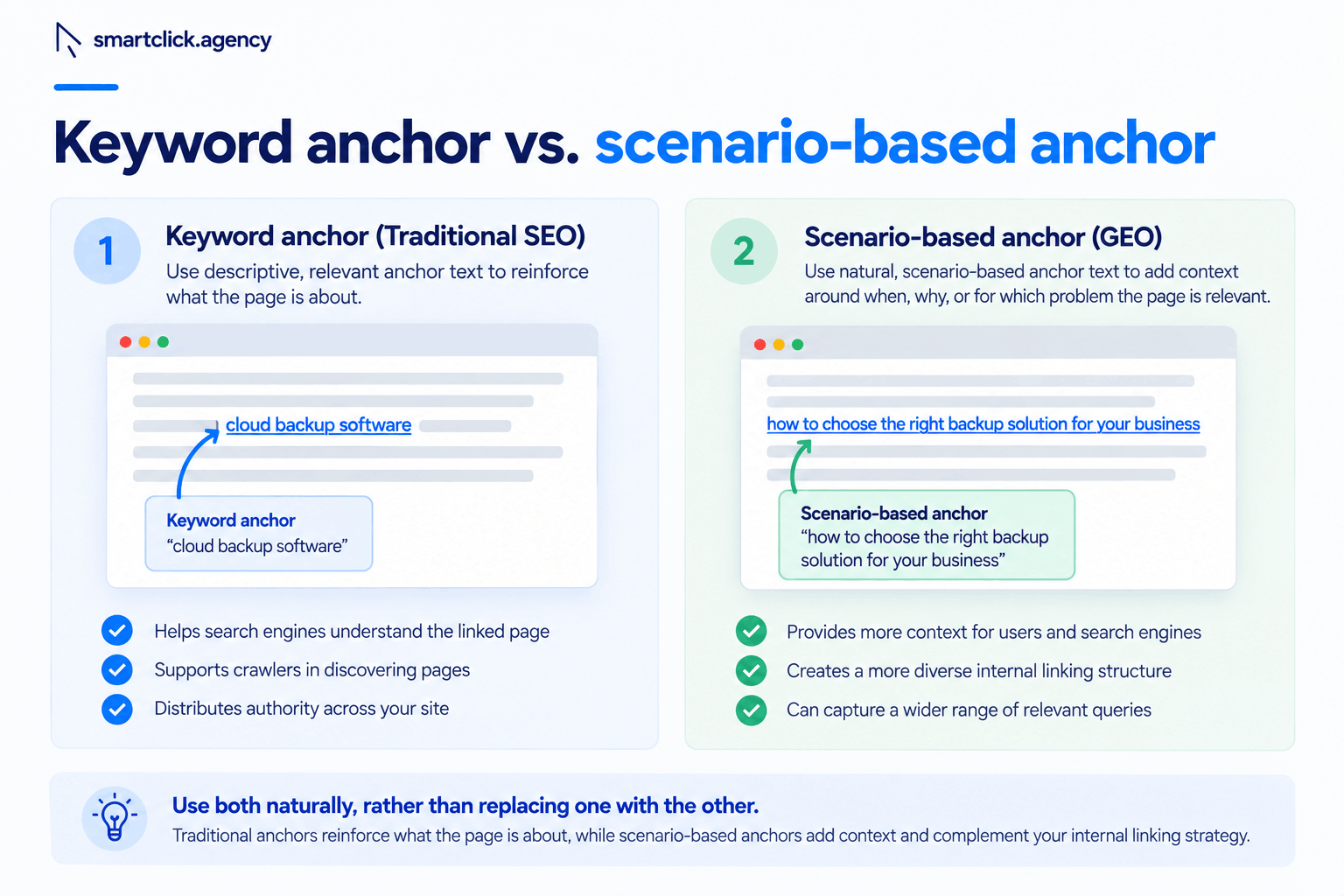
Traditional internal linking typically uses keyword-focused anchors that describe the destination page.
For example, a page about a technical SEO audit might be linked using “technical SEO audit”.
For AI visibility, people don’t search keywords on AI search engines. They try to explain the whole situation in a more conversational way.
So, instead of writing a keyword phrase, they take a more scenario-based approach as a prompt, such as: “My organic traffic suddenly dropped. How do I figure out what went wrong?” or even longer.
The anchor text linking to the same technical SEO audit page could be “diagnosing why organic traffic suddenly dropped.” This anchor reflects the question, problem, and situation from the prompt, while giving AI systems more context about the destination page. This way, the anchor link reinforces the semantic relationship between the two pages and makes a more connected topic cluster.
Connect the pages with an anchor that will actually describe the situation in which someone would need that page.
The question that comes up constantly: How many internal links should a single page have?
There is no fixed number that works for every page. The relationship between the pages and the anchor you use carries more weight.
For AI visibility, build link density around important topics, entities, and scenarios that you want your brand to be associated with.
If several relevant articles naturally point to the same core page from different contextual angles, you create a stronger network of relationships around that topic.
Don’t obsess about the number. The main focus is to create relevant connections between your pages.
We applied this approach with TailoredCV by organizing content into topical clusters and restructuring internal links and anchor text to reflect the real buyer journey.
Combined with content consolidation and stronger topical authority, this helped TailoredCV achieve 100+ AI citations and 500+ brand mentions across ChatGPT, Gemini, Perplexity, and Claude, alongside a 1,227% increase in organic clicks.
Descriptive, relevant anchor text still helps search engines understand what the linked page is about and how it relates to the page linking to it. It also helps crawlers discover pages and distribute authority throughout your site.
Use scenario-based anchor text to provide more context and create a more diverse internal linking structure.
Traditional anchors reinforce what the page is about, while scenario-based anchors can add context around when, why, or for which problem the page is relevant.
Use both naturally, rather than replacing one with the other.
Internal Linking for AI Visibility: A Repeatable System
Treat AI internal linking strategy as an ongoing process.
Audit your site
Organize pages into clusters
Fix orphan pages
Connect pillar and cluster pages
Use descriptive and contextual anchor text
Fix broken links
The same strategy applies to traditional search and AI retrieval: clear cluster architecture, anchor text quality, and crawl depth. The sites that already built a coherent internal linking strategy may have a structural advantage as AI search continues to grow.
But internal linking is only one piece of AI visibility. At SmartClick, we build visibility across Google and AI search by combining technical SEO, content architecture, topical authority, and AI search optimization.
FAQs
How can internal linking for AI visibility help?
Internal linking helps AI systems discover your content in depth, understand how your pages are related to each other, and judge if the content is worth citing. Well-structured internal links give AI retrieval systems the context they need to connect related information across your site, rather than treating each page as an isolated piece of content.
How many internal links should a page have?
There is no fixed number that works for every page. Focus on whether each link helps users and search engines understand the connection between your pages. That said, a page with zero or one internal link is invisible to AI systems, no matter how good the content is.
Can internal links alone improve AI visibility?
No. Internal linking is an important part of a broader GEO strategy, but it works alongside high-quality content, topical authority, technical SEO, and overall website health. Together, these factors can help make your content easier for AI systems to discover, understand, and retrieve.
How is internal linking for AI search different from traditional SEO?
Traditional SEO internal linking works like a roadmap, it helps search engine crawlers find your pages and understand site structure to build authority. AI systems look deeper into your site, the context and depth behind the content.
Should I link between different topical clusters?
Yes. Cross-linking within a cluster is what builds a strong, clear, and consistent signal for AI systems. Link each cluster page to another relevant cluster page to build a strong connection between the page and the topic as a whole.
How does anchor text reinforce the semantic relationship between two pages?
When an AI system follows a link, it doesn’t just look at the anchor text alone. It reads the surrounding text to understand why those pages are connected. So, a descriptive anchor text explains the relationship between those pages, rather than using a generic “click here”. For AI visibility, using scenario-based anchors gives even more context to AI search engines, since they are structured the way people actually phrase their problems in the prompt.
Let’s Solve Your SEO Challenges and Bring You Traffic That Converts
Book a free consultation today to learn how we can help you attract more of the right traffic and turn it into qualified leads for steady growth.