Business
Leads Don’t Mean Pipeline: Why SaaS Companies Are Measuring SEO Wrong
More leads don’t translate into more pipeline

Is AI search driving traffic to your saas
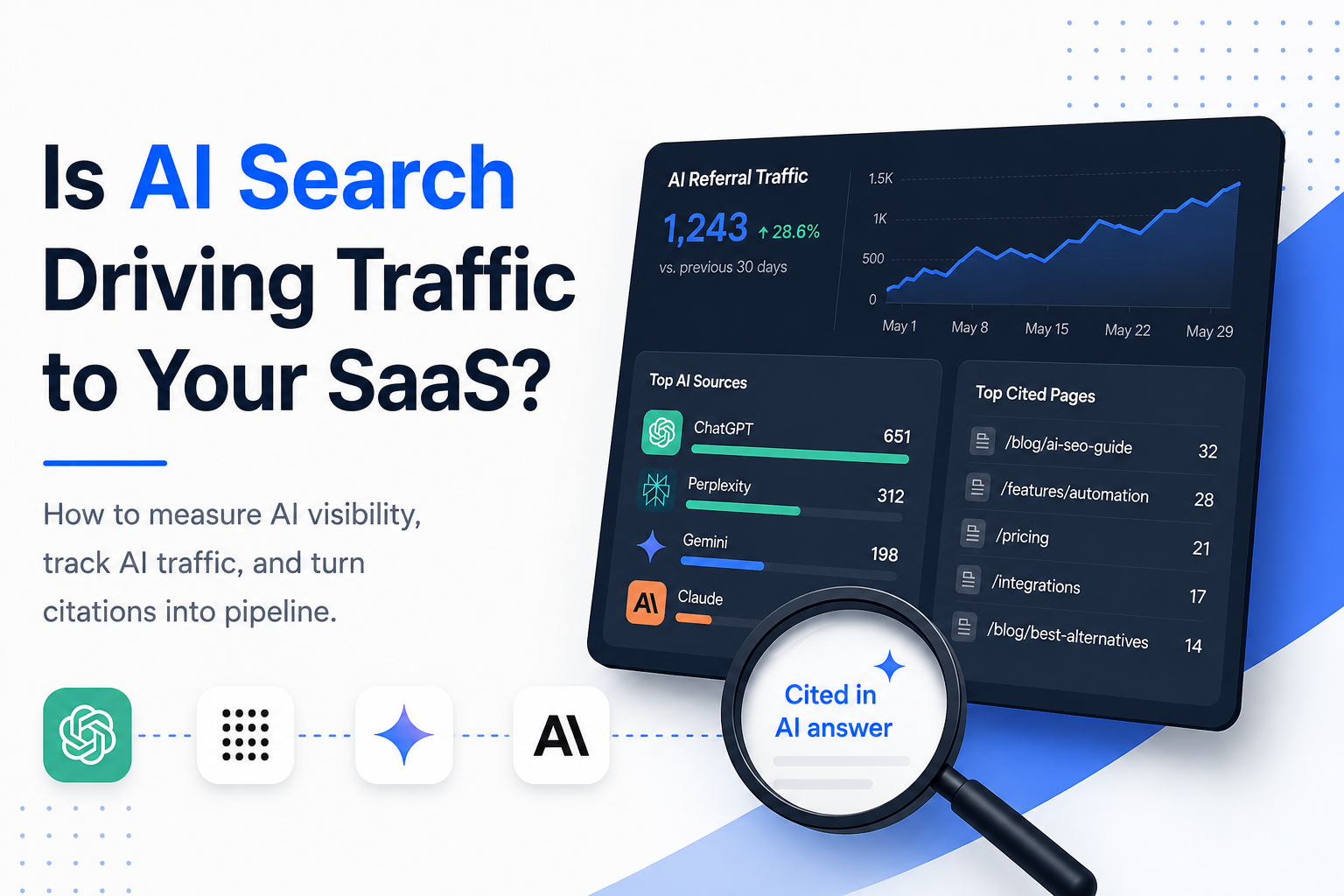
Open your analytics and you can probably tell me how much traffic came from Google last month.
You know which pages ranked, which keywords moved, how much organic traffic you generated, and hopefully how many leads came from it.
Now answer the same questions for ChatGPT.
How often does your SaaS appear when someone asks for tools in your category? Which prompts trigger your brand? Is ChatGPT recommending you or your competitors? Which pages are being cited? Is any of that visibility sending people to your website and eventually into your pipeline?
For a lot of SaaS teams, the answer is still:
We don’t really know.
And that’s becoming a blind spot.
Your buyers can now ask ChatGPT, Gemini, Perplexity, and other AI platforms questions they previously typed into a search engine. ChatGPT Search, for example, can search the web and provide citations that take users directly to the sources behind its answers.
Those questions might look like:
Your SaaS can be part of those answers, completely absent from them, or consistently losing the recommendation to the same three competitors.
Unless you’re measuring it, you have no idea which one is happening.
This distinction matters.
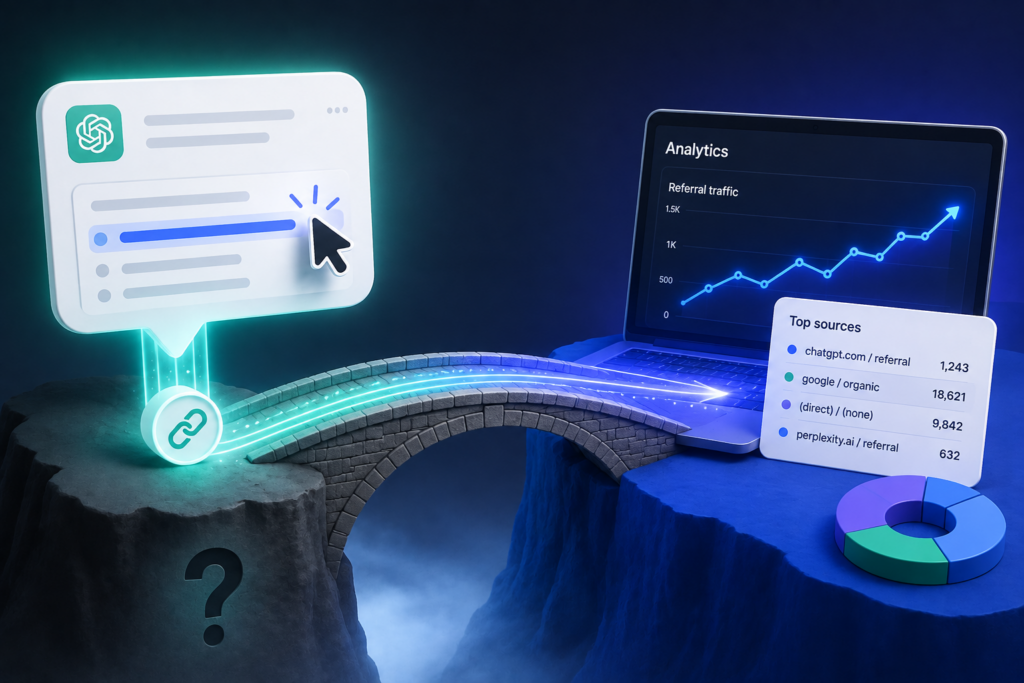
If someone clicks a citation in ChatGPT and lands on your website, that visit can potentially appear in your analytics as referral traffic. GA4’s Source dimension identifies the specific platform, website, app, or other location that referred a visitor, while Medium categorizes how that traffic arrived.
Useful, but incomplete.
Someone could ask ChatGPT for the best software in your category, see your company recommended alongside three competitors, research all four separately, and eventually visit your website through Google or directly.
ChatGPT may have influenced the buying journey without being credited for the eventual visit.
That means SaaS companies need to look at two different layers.
This is traffic that reaches your website directly from AI platforms such as:
Tracking AI referral traffic helps you understand whether AI platforms are becoming a measurable acquisition source for your SaaS.
AI visibility looks at something broader:
How often is your brand mentioned, cited, or recommended when your target buyers ask commercially relevant questions?
That matters even when the user never clicks the citation.
This is why measuring AI search requires more than adding another traffic channel to your GA4 report.
If you want to go deeper into the distinction between ranking and being cited, we’ve covered it in our guide to building an AEO strategy for SaaS.
One mistake I see is companies measuring AI visibility with random prompts.
If you sell project management software, knowing whether ChatGPT mentions your brand when someone asks “What is project management?” isn’t particularly useful.
I’d start much closer to the buying decision.
What are the best [category] platforms for [ICP]?
We’re a [company type] struggling with [problem]. What tools should we consider?
What is the best [category] software for [specific use case]?
What are the best alternatives to [competitor]?
[Your SaaS] vs. [competitor]. Which is better for [ICP]?
We’re a [company type] with [specific requirements]. Which [category] platforms should we shortlist?
Now you’re testing questions that could realistically influence a buying decision.
And don’t stop at the initial prompt.
AI search systems can expand a user’s question into related searches and subtopics. We explain how that process can affect SaaS visibility in our guide to query fan-out and AI search.
You don’t need an expensive dashboard to get your first baseline.
Pick 10 commercially relevant prompts and test them across ChatGPT, Gemini, and Perplexity.
Document what happens:
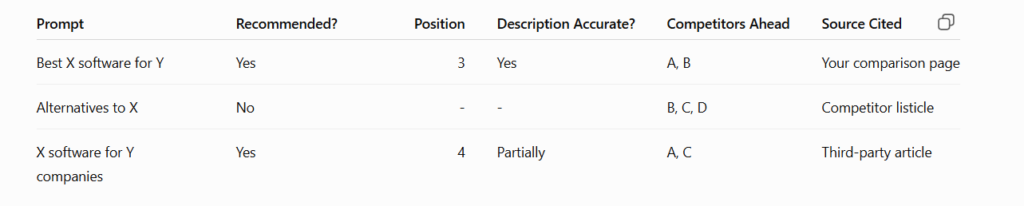
Then calculate a simple baseline:
Recommendation rate = Prompts where your SaaS was recommended ÷ Total prompts tested
If you appeared in 3 out of 10 buying prompts, your recommendation rate is 30%.
I wouldn’t obsess over the percentage itself. AI answers can vary between platforms and over time.
The important thing is that now you have a baseline.
Repeat the same test consistently and you can start answering much more useful questions:
This is essentially the first stage of an AI visibility audit.
Finding out that your SaaS is invisible for an important prompt is only the beginning.
The useful question is:
Why did the AI recommend those companies instead of us?
When we investigate AI visibility for SaaS companies, I’d look at five areas.
Start with the basics.
Can AI crawlers access the pages containing the information you want surfaced?
Check things like:
Before trying to optimize individual paragraphs for citations, make sure the underlying site is technically accessible.
This is also why we don’t treat AI optimization as completely separate from SEO. Our broader LLM SEO best-practices guide covers the technical and content foundations behind both.
Your website might make perfect sense internally while being surprisingly vague to someone encountering your company for the first time.
Ask whether your content clearly communicates:
If those relationships aren’t clear, expecting an AI system to confidently recommend your SaaS is a big ask.
Saying you’re the best solution on your own website isn’t particularly strong evidence.
AI systems can use information from sources beyond your domain when constructing answers.
For example, Perplexity visibly cites the sources behind its responses and has introduced source labels that distinguish certain government, academic, and trusted domains.
So look beyond your own website.
What do review platforms say about you?
Which industry publications mention you?
Are you included in relevant comparisons?
What do customers say in communities?
What information appears when someone researches your brand independently?
We go deeper into the role of third-party authority in our guide to brand mentions, links, and AI citations.
AI visibility isn’t disconnected from SEO.
If your competitors consistently rank across the category, comparison, alternative, and use-case searches surrounding your product while you barely appear, I wouldn’t jump straight into some separate GEO playbook.
There may be a more fundamental authority problem.
Build the search foundation, then make your information easier for AI systems to understand, extract, verify, and cite.
That’s also why we think about AI visibility as an extension of organic search rather than a replacement for it.
This one gets overlooked.
If your article says essentially the same thing as 50 competing articles, why should an AI system choose yours?
Give it something useful to work with:
The question shouldn’t only be:
How do we get cited?
Ask:
What have we published that deserves to be cited?
We’ve written more about this in our guide to making your SaaS brand citable in AI search.
Once AI platforms start sending visitors to your website, you also want to understand what those visitors do.
GA4’s traffic-source dimensions allow you to analyze where users and sessions originated, including referral sources.
Rather than looking only at the number of AI referrals, compare their behavior with other acquisition channels.
Look at:
That last part matters.
Because AI traffic isn’t automatically valuable traffic.
A hundred visits from ChatGPT that produce no meaningful action and ten visits that create three qualified opportunities tell very different stories.
SEO spent years obsessing over rankings and traffic without always connecting them to revenue.
We shouldn’t repeat the same mistake with AI citations.
Being mentioned hundreds of times sounds impressive.
But what did those mentions contribute to?
Eventually, I want to understand the relationship between:
AI visibility → AI referral traffic → Engaged visits → Leads → MQLs → Opportunities → Pipeline
That journey won’t always be clean.
AI can influence someone without producing a direct click. Buyers can discover you in ChatGPT, return through Google, visit directly a week later, and eventually book a demo.
So don’t expect perfect attribution.
Instead, look at AI visibility alongside your other acquisition and commercial metrics.
The same principle applies to SEO. As we’ve written before, more leads don’t necessarily translate into more pipeline.
Here’s the test.
Could you answer these questions today?
If you can’t answer them yet, that doesn’t automatically mean you have an AI visibility problem.
It means you don’t have a baseline.
And that’s where I’d start.
At SmartClick, our AI SEO services for B2B SaaS look at both sides of the equation: traditional organic search and how your brand appears across AI-generated answers.
We analyze where your SaaS currently appears, which competitors are being recommended instead, which sources are influencing those answers, and what may be preventing your brand from showing up.
The first step is a free mini-analysis.
We’ll give you an initial look at where your SaaS stands across AI search before you decide whether there’s anything worth fixing.
Get Your Free AI Visibility Mini-Analysis
Book a free consultation today to learn how we can help you attract more of the right traffic and turn it into qualified leads for steady growth.





Results

Results

Results

Results
















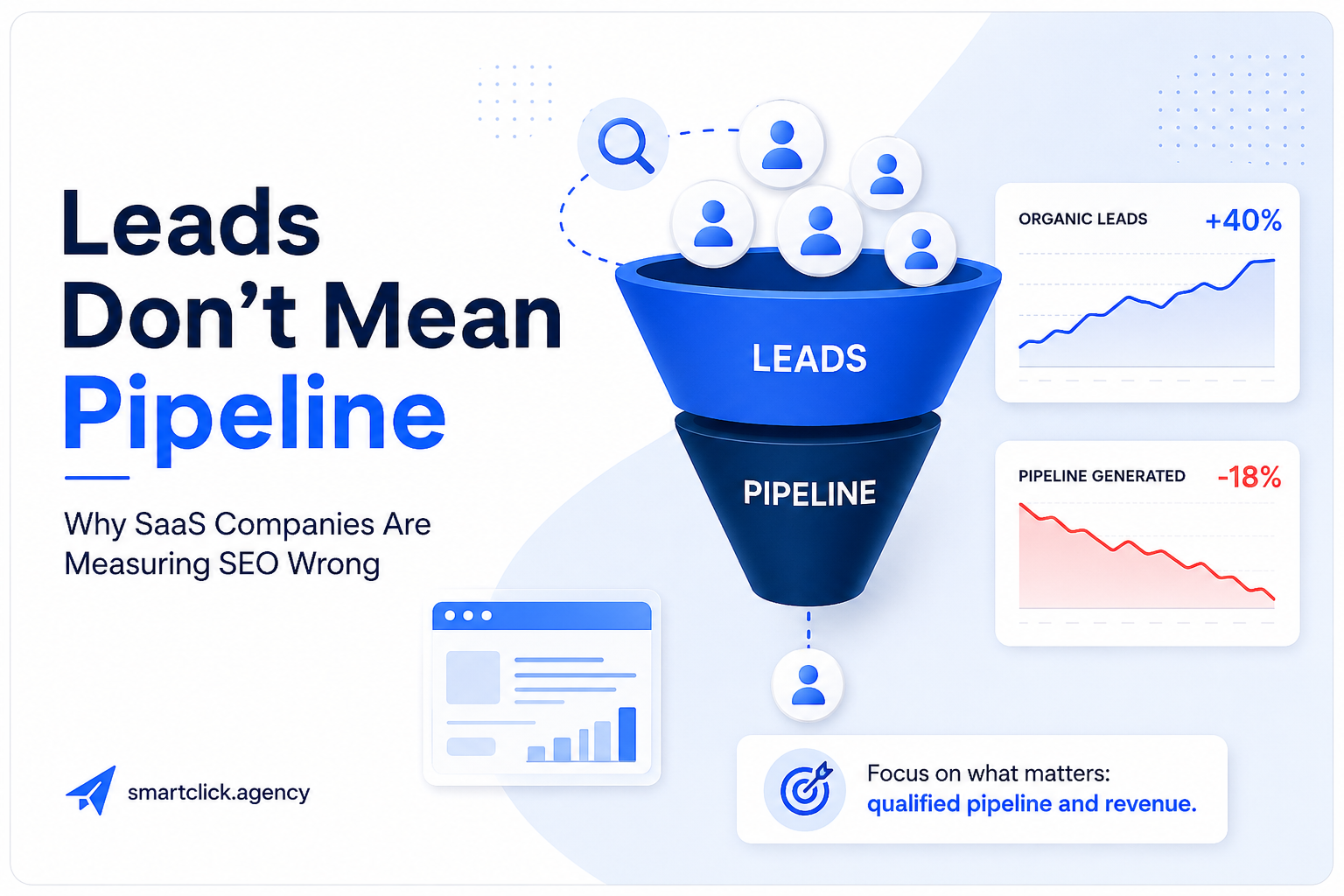
More leads don’t translate into more pipeline
From Ranking to Recommendation
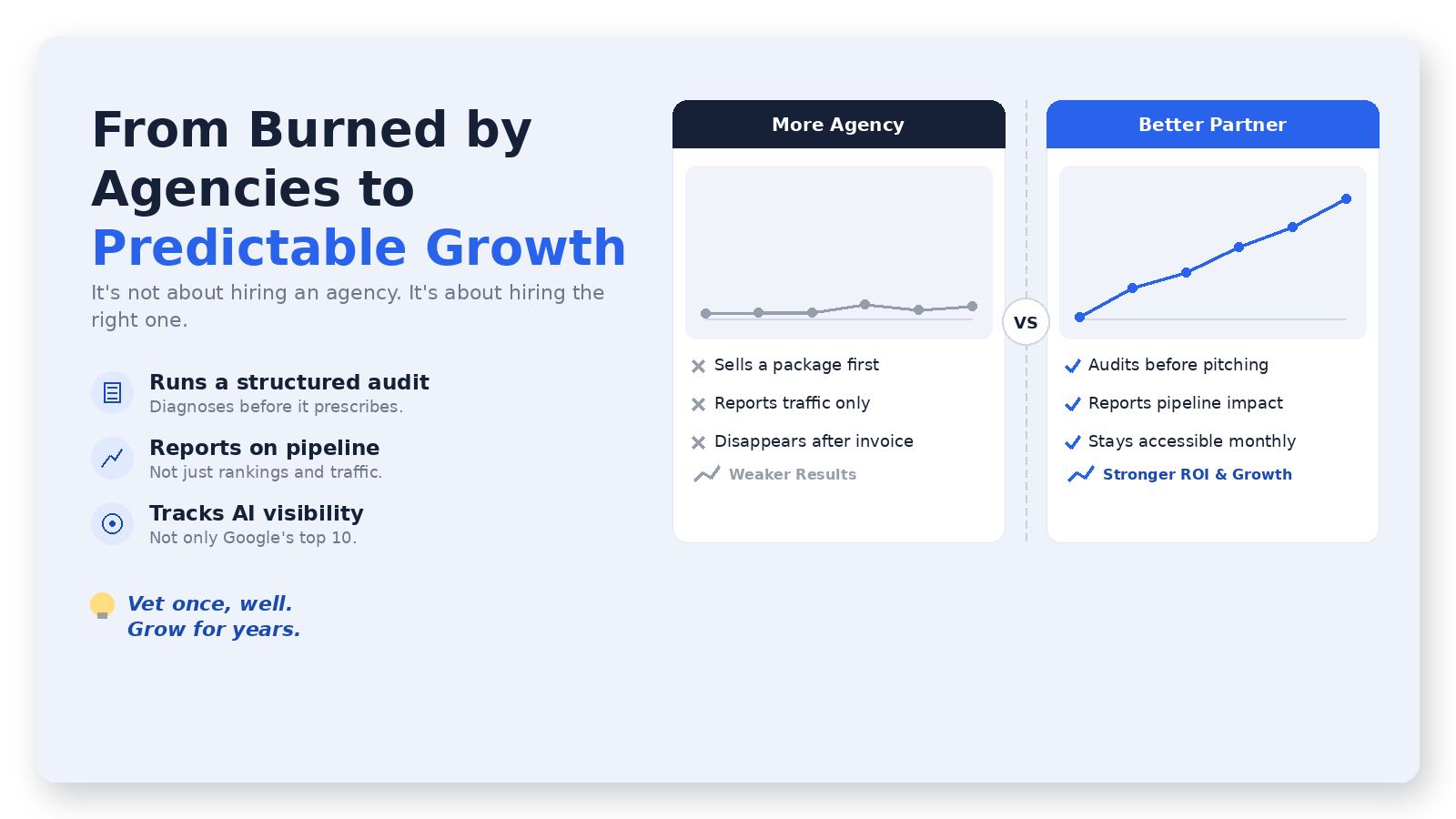
How do you know if your SEO partner is actually the right one?
Don’t let your competitors take the lead!